“All wars are civil wars, because all
men are brothers. Each one owes infinitely more to the human race than to the
particular country in which he was born.”
This is a controversial topic that I have wanted to summarise my thoughts on
for some time, and my answer to the question posed is 'no'. To clarify the
meaning of the title, by 'soldiers' I mean people who fight in an army as part
of their job currently, and by 'not heroes' I mean not possessing the qualities
of a hero by virtue of being a soldier. I will first summarise why soldiers
should not be considered heroes, then tackle the 'pro-hero' arguments, and
finish by discussing the potential dangers of the hero worship of soldiers.
Why Soldiers are Not Heroes
The crux of my argument lies on the nature of a soldier's job; this being
that, amongst other things, the primary job of a soldier is to kill others as
part of a war. This is an inescapable fact, and a fact that people often forget
or ignore, unconsciously or wilfully. This is my first premise.
My second premise is, to some, less easy to accept. This is that killing is
a fundamentally immoral activity, unless it is done as an absolute last resort
in self-defence or the defence of another. You may be thinking that this is the
perfect description of the reasons that soldiers kill, but on closer
examination it is not. Soldiers have made a concious decision to join the army,
and have allowed themselves to be shipped out to whatever country they are now
in, and accepted the orders to kill another human being. They have not been
conscripted or otherwise forced, and have had the chance to not take part at
many occasions.
It follows that the job of the soldier is an inherently immoral one, and
that whatever individuals may do to exceed themselves, it doesn't negate this
fact. It is true that soldiers can do heroic things, like throw themselves onto
grenades to save their comrades, but this does not make all soldiers heroes,
and does not necessarily make the individual a hero outright - as an analogy, imagine a
Taliban fighter doing the same thing, of throwing himself over a grenade. Would
that make him a hero, even though he has been a member of a horrifically
violent and amoral fundamentalist group? The example is extreme, but apt
nonetheless.
Perhaps a very small number of soldiers could be considered heroes by virtue
of their actions, but note that these actions would almost certainly not be of
a violent nature, and that non-soldiers also perform acts of equally laudable
heroism without the civilian groups they are part of being considered as
comprised only of heroes. To call all soldiers heroes is an absurdity (unless
killing is much more acceptable to you than I) and dangerous, as I will come to
later.
Debunking the Counter-Arguments
The argument most often put forward for the heroism of soldiers is that,
without them, we would not be speaking English/not living in England/not be
alive, and so on. Not only does this argument not apply to any conflict for the
last 70 years, but it ignores that pacifist position that all are
undesirable - not just the British one! I won't comment on whether the soldiers
of WW2 are all (or most) heroes, as it's a complex and difficult issue that I
dare not try to tackle, but the fact remains that soldiers currently fighting
in Afghanistan, and Iraq until recently, are not 'defending our nation' in the
profound way that some suggest.
Another similar, and even more vague, argument is that without soldiers we
would not have freedom, and that I would not be able to profess these
'disgusting' views. Perhaps if we, again, go 70 years back this may have some
truth. If anything, wars have damaged freedom, causing an approximate
seven-fold increase in terrorism since the invasion of Iraq, which has led to a
reduction in freedoms since the implementation of domestic policies to combat
terrorism. I won't give more than a sentence to the argument interchangeable
with this; that soldiers are 'defending our country' - a ridiculous claim for
any recent conflict on the face of it (Taliban ground invasion anyone?).
I will try to deal with the other minor arguments in this paragraph by use
of analogy. Take a typical Taliban fighter. The chances are that he is not bent
on 'Global Jihad' or terrorism, but instead considers it to be his duty to
fight against foreign invaders. Surveys have shown this to be true, with a
majority fighting with the, perhaps misguided, intention of defending their country, and a very
high percentage having lost a close relative to the conflict. It is therefore
comparable, in that a majority have (perceived) noble intentions, much like for NATO soldiers, a very small minority of whom doubtless have
extreme Islamaphobic attitudes, or are in it for the sake of being able to kill people. Note
that this person is actually putting themselves in far greater risk than a NATO soldier,
as he statistically has a much higher probability of being killed.
On almost all levels, the Taliban fighter and NATO soldier are much the
same, if any particularly heroic (and uncommon) actions are not considered. Do
we call them both heroes? I don't know about you, but I'm not in the habit of
calling members of brutal fundamentalist groups heroes, so it is more
reasonable to call neither heroes. It is what people do that matters - not what
they are, or what they intend to do.
Why Hero-Worship is Dangerous
“War will exist until that distant day when the
conscientious objector enjoys the same reputation and prestige that the warrior
does today.”
I hope that I have convinced you that not all soldiers should be immediately
named as heroes, but if not, and even if I have, you may still ask what the
harm is, if it helps support the soldiers and their families (both of which I do
sympathise with very much!) The answer is that the universal praise of soldiers
is the beginning of a dark path to the acceptance of violence and killing.
If we consider killing to be acceptable (never mind laudable!) if it is done
with the 'good intentions' of war, or that it is not immoral if the person
being killed has been judged to be evil and undeserving of life by his
membership of a particular group alone, then we have become, in the absence of
an alternative word, much like Nazis, even if these groups are deserving of
hatred. If we demonise a group to such an extent (not that the Taliban or
Saddam Hussein's regime etc. should not be demonised) that the people who
fight, injure and kill its members are to be worshipped as 'heroes', and anyone
who says otherwise is attacked so voraciously, then we are no longer a
civilised society that values the life, equality and justice that many claim
soldiers are actively defending.
Perhaps even more dangerous is that hero-worship detracts from tackling the true
reasons why war, and specific wars, happen. Burying these reasons in a tide of
patriotism, and excusing the belligerents (at all levels) because they have ‘good
intentions’ runs the risk of creating a society that is apathetic to violence,
and uninterested in peace. It is time that we looked up to the conscientious
objectors – those who have inquired about what they are truly fighting for or
against, and have risked punishment and ridicule for doing what it right, and
refusing to play a part in organised homocide.
Well, it's been while since I last posted here, due to exams and such, but I should hopefully be able to write more frequently from now on. As the title suggests, this is about SETI (the search for extra-terrestrial intelligence if you really prefer), its worth, and its implications.
Where is Everebody?
SETI is what it says on the tin - the searching of the universe for other intelligent species like ourselves (at least some of the time), although not necessarily a lot like ourselves. Limitations on our current technology clearly prevent us from partaking in this search in person, so we've had to resort to listening for, and sending out, signals from and to outer space. We should first examine the likelihood that anyone is actually out there.
The good news is that someone has already beaten us to it, namely Frank Drake, with his formula know as the Drake equation, with which the number of communicating extra-terrestrial civilization can be estimated. The bad news is that the equation has seven variables, of which only two are known with any certainty, although we have some idea of the values of a couple of others. Here it is:
N here is the number of detectable extra-terrestrial civilizations in our galaxy, the Milky Way. Let's take each variable in turn, which become estimated with less and less certainty as you go on.
R, the average rate of star formation, is the one variable that we can be sure is about right. In our galaxy, around seven stars are formed each Earth year; no mean feat considering that each one is likely to last for many billions of years.
fp , the fraction of good stars (meaning stars that aren't pathetic white dwarfs, or over-sized giants) varies from around 20% to almost 100%. For the sake of neutrality, I'll go for the value in the middle: 60%.
ne, the average number of planets (or possibly moons, *ehem* Avatar *ehem*) that are capable of supporting life in those systems that have any planets at all, is a value that is only just now being investigated. Initial estimate suggest that perhaps around 10% of planets are capable of supporting life. If we take our own solar system as a rough guide, that works out to around one planet capable of supporting life. As a sample size of 1 isn't great, I'm going to use the, perhaps conservative, figure of an average of 0.2 earth-like planets per star.
fl , the fraction of those planets where life actually develops. For the purpose of not resorting to pure guesswork already, I'll use the figure of 0.2, based on the time that it took for life to develop on Earth.
fi , the fraction of planets on which life develops where a species evolves intelligence. I'm going to use an educated guess of 0.05, since, given enough time, the evolution of intelligence seems likely, but by no means certain.
fc , the fraction of those species that possess, and are using, communications technology. Again, I'm going to use the figure of 0.1, based on the length of time that we have been using communication technologies as a fraction of our total length of existence, past and future, and the possibility that some intelligent species struggle to form a civilization.
L, the length of the 'communicative phase', which is likely to correspond to the length that the civilization exists. This is an interesting variable which warrants longer discussion. There have been several points in our recent history at which we have come close to the end of civilization, all of which have been due to the threat of nuclear weapons, and indeed our continued future is threatened by climate change. However, it isn't as simple as working how long, on average, it takes for someone to accidentally detonate a nuclear weapon, or how long a species can keep their climate stable. This is because a civilization even a little more advanced than ours would be able to establish colonies on nearby planets and moons, and given a little more time, on the planets of other stars. When a species reaches this stage of development, they could become essentially immortal, even if their home star died (they could simply migrate to another). Therefore, I'm going to tentatively suggest an average of 1,000,000 years; still a tiny fraction of the total age of the universe.
And now, the moment of truth:
(7 x 0.6 x 0.2 x 0.2 x 0.05 x 0.1 x 1000000) - 1 [us!] = 839 detectable civilizations in our galaxy, and therefore about 80 trillion in our universe. But where on Earth (well, not) are they?
The Fermi Paradox
From the above calculation, it would seem that our galaxy, and universe, are abuzz with life. Unless you happen to believe the UFO nuts, you might have noticed that we haven't seen much of these 800-something civilizations, and don't even have a smidgen of evidence. This apparent contradiction is known as the Fermi Paradox.
One way to resolve the paradox is glaringly obvious - the calculation seems to be really quite naff, and it is indeed! If we change the values for the percentage of life-supporting planets that develop life from 0.2 to 0.05, and the fraction of intelligent species using communicative technologies from 0.1 to 0.01 (these change are not at all unreasonable, and would still be considered very optimistic by many), we now come to a figure of just 21. With just a little more adjustment and we can come to a figure of 1 or less.
There are many other explanations that have been proposed, including that a majority of civilizations destroy themselves too quickly (although this has already been taken into account in the equation), that most species have a policy of non-interference, much like the 'Prime Directive' of Star Trek, or simply that they don't want to communicate.
First Contact
Let's imagine that somewhere amongst the hundreds of billions of stars of the Milky Way, there is an intelligent species other than our own. How might contact happen, and what would be the consequences?
As suggested earlier, it's likely that initial contact would occur via communication technology; either with us receiving a message from outer space, or with them receiving one of our messages, such as the Arecibo message. You might be wondering how this is going to work, since we are certain to use utterly different language. Instead of our own languages, we have used the universal languages, of mathematics and science, which (probably) are the same for all intelligent beings.
However, this method of communication is severely limited by the many tens, or hundreds, of years that it would take for a reply to travel back across the vast expanses of space. Regardless, this is the only line of inquiry pursued by SETI organisations.
The most interesting form of contact, popularised in countless books, films and games, is that of direct contact; as in aliens visiting Earth in person. You many have noticed that a theme running through the portrayal of direct contact in these media sources is that this first contact doesn't often end well for Humanity.
In my opinion, it is unlikely that this would be the reaction of another civilisation to out own. For a species to survive its technological adolescence, it cannot have been so bellicose that it would attack other species on sight. A more likely response would be similar to our own; that they've just discovered another intelligent species, perhaps the first they have ever encountered, and that annihilation is not the best course of action.
What might be the effect of first contact on our own species and society? You'll have to wait for part 2 to find out...
Only 4 months after I began this blog, it's now time for the sixth and final introductory post, and this one is about the topic for which most people's first question is 'What is Sociology?' Read on to find out!
What is Sociology?
The short answer is the sociology is the study of society. The longer answer is that sociology is the study of human life, social groups, entire societies and the human world as a whole. It is the central social science around which the other social sciences, including economics, political science and human geography, revolve.
It deals not only with how society functions, but also how, and why, societies transform over time. It ranges from macro-sociology, or the study of entire societies (such as countries), to micro-sociology, which is concerned with the everyday interactions between people. There are, of course, intermediate levels, such as the study of small societies, such as town or neighbourhoods.
Sociology covers issues from gender to war, from health care to religion, and from globalisation to why you're reading this post right now. It is, in my opinion, the most complex and controversial science, and changes more than any other that I can think of, but is ultimately the most important, as I'll explain later.
Approaches in Sociology
There are a plethora of theoretical approaches in sociology, but these are dominated by three central approaches: functionalism, conflict theories and symbolic interactionism. It is important to note that these are not grand theories of societies' functioning and change, but approaches that help sociologists develop theories of human society. The theoretical approaches provide a framework for sociological research, without which there would most likely be a jumbled mess of theories, and little to no progress in our understanding of society.
The first theoretical approach to be developed, and for a while considered the only approach, is functionalism. Originally proposed by the fouder of sociology, Auguste Comte, as well as Emile Durkheim, functionalism treats society as having various components that work together to produce stability and solidarity. Therefore, theories based on the functionalist approach tend to relate to how parts of society relate and interact with other parts, as well as society as whole. One analogy is treating society like the human body, with various organs (social institutions) working together to keep the person alive (keep society stable and functioning). However, the approach has been criticised for its emphasis on macrosociology, and its failure to explain societal conflict and change.
From left to right: Marx, Comte, Durkheim
The second approach is the conflict theories. Karl Marx, although not actually a sociologist, is often credited with founding this area of sociological thought. While functionalism sees society as being stable, conflict theorists view it as being fraught with conflicts between groups and individuals, both open and underlying. This could be conflict between religious, racial and national groups, but is most often considered to be between different economic groups (the Marxist approach). Oppositely to functionalism, the conflict approach has been criticised for its lack of focus on how societies can remain stable.
The third approach, symbolic interactionism, has not been as influential as the first two. Max Weber is usually considered to have founded this school of sociology in his work on the origins of capitalism. This approach concentrates on, as its name suggest, interactions between individual people, in the form of symbols - meaning anything that can stand for something, such as a word or gesture.While the functionalist approach sees society as having a controlling or limiting effect on its members, symbolic interactionism stresses the ability of individuals to shape society. Symbolic interactionism has been criticised for its lack of explanation for larger institutions and macrosociological phenomena.
In recent years, many sociologists have tried to create theoretical syntheses that take elements for some or all of the classical approaches to sociology. It is probable that no single approach will be enough to develop theories for every element of society, from the micro to the macro level, and from societal stability to collapse.
Why Bother?
I've touched briefly on the importance of sociology to humanity's prospering, and perhaps its very survival. On a wider level, sociology is crucial to successful policy making. It's useless implementing sweeping reforms that might look great on paper when it's impact on people, and their likely reaction, hasn't been considered. Without an understanding of social dynamics, any government initiatives can easily backfire.
Through sociology, and the other social sciences, we can begin to get an idea of what the future may hold for human civilisation, and possible directions that society will take. Sociology also aids us in finding solutions to pressing crises, such as climate change, energy/food insecurity and the danger of international conflict, that will take the differing nature of human societies into account when trying to avert disaster.
On a personal level, studying sociology provides a greater awareness of cultural differences, from which it is possible to gain a higher level of tolerance of other people, and the ability to carefully consider what circumstances others might be in before labelling them as a 'chav', 'snob', 'bible-basher' or any other class that it is so easy to place people into without more that a moment's thought (sorry for how long that sentence was).
It has provided me with an interesting challenge in that it is important to put your personal beliefs and values aside in sociology. Possessing the strong opinions that I have, this was a difficult thing to accomplish, but I believe that it has helped to me strengthen and develop them further, having been able to re-consider my views from a different perspective.
The penultimate introductory piece is ethics, and it's a discussion of the biological and cultural roots of morality. Although this doesn't relate directly to any ethical debate, and is more a scientific topic than an ethical, it is an interesting topic that's worth spending some time on. The article is split into two sections: The genetic/evolutionary roots of morality, and the cultural roots of morality.
Biological Roots
Family Values
Imagine that you are a gene (as in a length of the DNA that lasts long enough to be evolutionarily significant [not necessarily coding for a single protein]), as unusual and difficult a request as that is. Now imagine that your main aim is to survive for long enough to be replicated (in humans through sexual reproduction). You also have a secondary aim; to help exact copies of yourself - for example, the ones your organism views as sibling and parents each share around 50% of your own organism's DNA, so have a 50% chance of having 'you'. Remember, you're just a sequence of bases, and are unable to directly influence the environment, but you are able to code for the physiology and psychology of the organism you are a part of - the real you! By giving your organism certain traits that other organisms might see as 'moral', and indeed other traits that could be seen as 'immoral', you can ensure your survival, and the survival of those who are likely to possess a replica of yourself.
This is a grossly simplified and anthropmorphised thought experiment. Your genes can no more select your characteristics than you can select the weather tomorrow, but over enormous lengths of time there is a process by which your genes can gain control over your characteristics - evolution. More precisely, evolution selects those genes which code for evolutionarily advantageous trait. Those organisms with 'bad' genes, both physiological and psychological, will die out, and those that have 'good' genes will flourish. For example, we can assume that a mutant gene that gives an organism an insatiable desire to slaughter all its relatives will not remain in the gene pool for very long. On the other hand, a gene that makes the organism a selfless being which lives purely to serve others and expects nothing in return will also exist for the briefest moment on an evolutionary timescale.
Now that you've been given a background, it's time to go back to the issue at hand. Why do we feel an innate empathy for those who are closely related to us (as well as partners), and will invest our time and energy for them even if we expect absolutely nothing in return - what most know as love. As I alluded to above, we share around 50% of our genetic material with immediate relatives, and smaller percentages with more distant relatives. From an evolutionary perspective, it makes sense that the human mind is geared towards wanting these relatives to survive and reproduce as well, as a gene that gives us a sense of family altruism will be very successful. It's worth spending a couple of minutes trying to get your head around this idea, as it is important to the rest of the article and is profound in its own right.
Evolution favours genes that produce organisms that invest time and energy into other organisms that are likely to share the same gene. This creates a self-reinforcing cycle - the reason why almost every animal has been observed to help out its family.
Reciprocal Altruism
So we've looked at the roots of family altruism, but the vast majority of people we meet aren't related to us. Why is it that we ever help out non-related people, and why do we expect them to help us?
In short, this is a case of "You scratch my back, I'll scratch yours". Seemingly altruistic acts are often carried out with the expectation of a return in the future from the person benefiting. I know how cynical that sounds, but in many situations it turns out to be true, even if we don't realise or want to accept it. As I mentioned earlier, genes that coded for an organism that would provide help at the expense of its own chances of survival would quickly die out, as the organism would be vunerable to exploitation to what we can call 'cheaters', who accept the saintly organism's aid but give nothing in return.
However, there's still hope for humanity! People could not be entirely selfish/exploitative. While genes could code for an organism that will only receive help without giving any in exchange, the rest of the population would evolve to identify cheaters, and evolve a mechanism against them, such as grudge holding if they don't return favours. Technically a small number of selfish organisms (or people) could exist, but it's unlikely that they would come to dominate the population.
The genetic roots of morality apply more to other animals than to humans, for the simple reason that we have evolved something unique - a brain that can make complex decisions for itself. We have moved beyond our genetic pre-programming to establish a higher, and occasionally a lesser, morality.
I should point out that most of the post so far is a summary of Richard Dawkin's 'The Selfish Gene' - a fantastic book that you should definitely read!
Cultural Roots
Memes
It has been proposed that a new, more rapid type of evolution has taken over where evolution left over. Instead of genes being propagated through the generations, there are now ideas or 'memes'. While genes use the organism as a host, and reproductino as a means of self-continuation, memes use the human brain as their host and the transmission of information (word of mouth or writing for most of human history) its means of continuation.
Just like genes, 'bad' memes, or those that are not memorable, relateble or useful, will die out, and the 'good' memes will survive and spread. An example of this is religion. Religion gives answers to deep and troubling questions about reality, as well as providing the possibility of good things in the future when the present is full of suffering. As a result, it has become a particularly successful meme, survivng for millenia and held by billions around the world. Likewise, ideas such as nationalism, racism, charity and countless others can come to be widely held if they are successful memes.
The other cultural sources of morality or immorality are well-known, so I won't waste your time telling you about them. These include religion, family, friends education and media, and probably many more that I haven't thought of.
Nature vs. Nurture
In the end, this entire issue of the roots of morality boils down to the classic nature vs. nurture debate. It's certain that both play important parts, but we may never know which has the greater role, and the discussion of it is beyond the scope of this post (but maybe I'll spend some time looking at it in the future!)
I'll leave you with a couple of things to think about:
1. If a person was seperated from other people from birth, and every man-made thing and piece of information (i.e. no culture whatsoever), would they see murder as inherently wrong?
2. If a person was taught from the age when they could first absorb information that murder is inherently good (not just the 'better of two evils', but a highly moral and righteous thing in its own right), and were not exposed to any information that would conflict with this (i.e. culture overload), would they come to believe that murder was a truly good thing?
Feel free to leave your opinion on these questions in the comments below.
Obviously my fourth introductory article is about science (and don't worry - you needn't be exposed to any more offensive language. That is, if you don't watch the video below - I know you won't be able to resist the temptation).
What is Science?
Science (from Latin scientia, meaning "knowledge") is a systematic enterprise that builds and organizes knowledge in the form of testable explanations and predictions about the universe. Yes, that was copied and pasted from Wikipedia, I know, but this definition really doesn't do it justice. Science is the process by which humanity may undertstand the world it inhabits. It is the way that the universe (we are all products of the universe) may know itself.
Science has showed itself to be a brilliant, and probably unsurpassable, tool for ascertaining the truth of reality. It doesn't carry prejudices, hold grudges or work towards its own ends, even if the people who carry it out might not always reach these ideals. Science is universal, existing beyond religions, nation-states or ideoligies. Science binds us all together.
I could go on all day about how great science is, but I'm guessing that it would be preaching to the converted if you even got this far. So instead I've picked out my favourite fields in science, and I'll talk a little about each of them.
This one's a no-brainer, not only because the human body is a truly fascinating thing, but because of the immeasurable benefits that this science has brought.
Walk over to the nearest mirror and take a look at yourself. You're staring at the product of 9 billion years of physcial and chemical evolution, from energy to the organic compounds that life is based on, followed by 4 billion years of biological evolution, from the simplest one-cell organisms to, well, you! Just think about the complex organs inside you, constantly working away to keep you alive, that have taken so long to come about.
While most sciences are driven more by curiosity (not to say that this one isn't), they usually only produce indirect benefits, whereas medical science can be translated directly into new treatments and procedures, benefiting humanity. We have medicine to thank for the fact that people with diabetes can live to adulthood, that being diagnosed with cancer is not an automatic death sentence, and that a majority of people live into their 70s and beyond (at least in developed countries).
Go back to that mirror again and take another look at yourself (this is the final time, I promise). The fact that you can see yourself, comprehend what you see and make judgements, deductions and decisions based on this is, in itself, an amazing thing. The human mind is, in my own human-chauvinistic opinion, the most wonderful thing in the known universe. Its complexities and intriacies make it something unparalleled anywhere in nature, at least on our own planet (but that's something for another day).
Humans have walked on the moon, looked into the reality of the universe and have developed the ability to wipe out life on a planetary scale; all because of the phenomenal power of the human mind. Psychology is unique in that it is something (the human mind) trying to understand itself. It is probably the field of science that has the most unanswered questions, and the most profound implications.
There are a couple of interesting essays about approaches in psychology on my blog written by a friend which are well worth reading. Personally, I see the cognitive approach as the best path to follow in attempting the understand the human mind, in particular the computational model of the mind, in which the brain acts as a sort of incredibly powerful and versatile computer.
Physics / Astrophysics
Physics has a special place in my heart. For a while I was intent on pursuing it as a career, but decided that it would not bring about the direct benefit to others that medicine does, so should just remain as an interest.
But now to physics itself. Physics is usually considered to be the purest of the sciences if we don't include mathematics, as it deals with the universe at its most fundamental level. It is one of the most diverse fields in science, covering everything from gluons to galactic superclusters, and certainly one of the most interesting. Many of the big questions of physics have been answered to an extent, but many remain, most prominently the search for a 'theory of everything'.
Physics has recently made a come-back into the public interest, with major projects such as the Large Hadron Collider, discoveries such as the (possible) faster-than-light neutrinos, and even television programmes such as The Big Bang Theory. We live in an exciting time for physics (and television!).
I have a particular interest in astrophysics; the study of celestial bodies - stars, galaxies, nebulae, quasars, black holes and a whole host of others. What originally sparked my interest in astrophysics was the sheer scale of the universe and the structures it contains. The universe contains between 10 sextillion and a septillion stars. That's 1,000,000,000,000,000,000,000,000 stars, which is over a million times more than the number of grains of sand in all the deserts and beaches on the earth.
Here's your reward for getting to the end!
So that's science in a nutshell! If there's one section of my blog that there will always be something to talk about, it's this one.
It's time for my third (of six) introductory pieces, and this time it's politics (do try to contain your excitement). I'm going to explain why I see capitalism, in it's current manifestation, as undesirable and unsustainable, whether capitalism can be modified into a more appropriate form, and a brief look at the alternatives.
What's wrong with Capitalism?
You will (or should!) already know what capitalism is, but in case you and your family have been living under a rock for the last couple of hundred years or you just need your memory jogging, click the link and take a look. In this part of the post I'm referring to the current corporate-capitalist system that prevails throughout most of the world. To give you a heads up, my criticisms of capitalism are split into three key sections - inequality and poverty perpetuated by capitalism, the instability and unsustainability of capitalism, and finally what I see as the immorality of capitalism.
Inequality - The Enemy of Peace, Happiness and Fullfillment
"In a world where 1 % of the population owns 40% of the planet's
wealth, where 34,000 children die every single day from
poverty and preventable diseases, and where 50% of the world's
population lives on less than 2 and a half dollars a day, one thing is clear...
Something is very wrong." - Peter Joseph
Like it or not, capitalism is based around inequality. More than that, it thrives on it, and perhaps even requires it to function properly. The foundation of capitalism is private ownership, the pursuit of profit and the accumulation of capital, which inevitably leads to those who have, and those who have not. From the few billionaires to the billions who scrape a living on a few dollars a day, capitalism, especially in its current form, is responsible for the deepest economic inequalities in the history of humanity, and these inequalities only continue to widen.
Not only is this level of inequality an abhorrent affront against human decency, it is linked to a whole host of social ills, from social alienation to the level of happiness, and from the number of teenage pregnancies to the suicide rate. Economic inequality tends to augment racial, religious, national and social inequalities.
Inequality is also the prime motivator in the desire for material accumulation at all levels of society, not because it will make us any happier, more fulfilled or healthier (although people often like to think it will), but simply because the enormous inequality and economic philosophy makes people feel that they must try to rise further up the ladder of wealth. Perhaps this is a natural impulse based on 'human nature', twisted by the context of modern society, but is likely to not be as I'll be discussing later (ooo... the anticipation!)
Equality should be one of the highest priorities of all governments, as promoting equality will certainly lead to a more stable, peaceful and productive society. This transition from institutionalised inequality to equality is not possible within the framework of our current economic system based on capitalism.
Poverty - Capitalism's Ultimate Crime
"The world has enough for everyone's need, but not for everyone's greed" - Gandhi
Poverty is, of course, tied closely to inequality. Those who exist in a state of poverty are those who live towards the bottom of the long scale of economic prosperity. Many reason are proposed for poverty, from the failure of the country's government to the 'laziness' of those who live in poverty, but when the issue is looked at closely in the context of our globalised world, only one reason emerges - the unequal allocation of resources, with a disproportionate amount going to primarily northern, 'developed', countries. This arises as a result of a capitalist system monopolised by the north.
Like for inequality, capitalism can thrive off poverty. It is useful firstly as a supply of cheap 'slave' labour, with those in abject poverty forced through their financial circumstances into dangerous, poorly paid and often brutally enforced manufacturing and agricultural jobs. It also serves as a warning to citizens of wealthier countries of the dangers of not fully embracing capitalist ideals (oh, the irony!), thus leading to poorly thought out arguments like 'capitalism is good because we have a high standard of living'. These arguments usually completely ignore the billions around the world who support that comparatively high standard of living, and the level to which resources are diverted to these countries, and away from the so called 'developing' nations.
Poverty, just like equality, can not be eliminated in a corporate-capitalist system, since a large number of people living in relative poverty is virtually a perquisite of the functioning of such a system.
Instability - The Death Throes of Capitalism? With the complex system of investment banks, stock markets and other such institutions with no tangible benefit to the vast majority of the world's people, the dominant economic system of the modern age has shown itself again and again to be highly, and increasingly, unsustainable.
Entire financial crises and recessions have been caused, not because there has been an decrease in the quantity of resources available, a decrease in the workforce size or some destructive event (such as a war or natural disaster), but simply because the risk-based system of investment, stock trading and a myriad of other such elements of the financial world has had a major screw-up. A major cause of the current economic downturn beginning in 2008 was such screw-ups, including the phantom 'derivatives market', which in 2009 stood at over $600 trillion (yes, trillion!) in value.
Although this element of instability is not a requisite of corporate capitalism, it currently plays and integral part in the current capitalist paradigm, and is likely to add further instability in the coming years if left unchecked. One thing that can be noted is that (with the exception of the Great Depression) economic crises and collapses have become more and more common over the decades, and increasingly severe, perhaps implying that capitalism is in its final death throes, and may soon make its final spectacular collapse. There is a second main reason for economic instability, which bring me nicely on to the unsustainability of capitalism.
Unsustainability - Infinite Growth faces a Finite World
"Oil depletion and climate change will create an entirely new context in
which political struggles will be played out. Within that context, it
is not just freedom, democracy, and equality that are at stake, but the
survival of billions of humans and of whole ecosystems." - Richard Heinberg
This is, I think, the most important of the arguments against capitalism, at least in its current form, as it shows how this system could potentially lead to societal and environmental collapse that threaten the continuation of civilisation itself. Accordingly, I'm going to spend quite a bit of time on it.
One important element of the consumerist-capitalist system is that it is based off an infinite growth model - that economic growth can continue indefinitely, and that the available resources will continue to increase with demand forever. However, we live on a finite world of finite resources, and so this sort of system can not continue to function for much longer under this premise.
By far the most important of these finite resources is crude oil. Oil is the lifeblood of modern civilisation. It is an incredibly dense energy supply that can be easily transported and used in a wide variety of machines. Without oil human societies would not have been able to grow in the same way they have and continue to, or reach the extraordinary levels of energy usage and societal complexity that we have today. But as everyone knows, oil will run out, but more importantly its production will reach a peak, after which the quantity of oil available per year decreases year on year.
This is known as the peak oil crisis, and there is strong evidence to suggest that it was a major factor in the economic downturn beginning in 2008. Immediately before the market crash, oil prices reached dizzying new heights that had never been experienced before. It looks likely that world oil production in around 2006, which would fit up perfectly with the subsequent rise in oil's price as the demand began to exceed the supply. As oil is required for most of the functioning of modern societies, from transport to agriculture, and from manufacture to electricity production, the astonishing increase in the price of oil helped to cause a major economic contraction. This contraction allowed the price of oil to plummet, thus allowing the now depleted supplies to build up again.
The world economy has begun to pick-up somewhat, and so demand for oil has increased accordingly. However, the initial problem still remains - that the peak in oil production has been reached, and therefore is not able to support much economic recovery at all before the supply again becomes severely restricted. If you look at the price of oil you will see that it remains at around $100 or over. Even a decade ago few people indeed would suggest that oil would ever reach that sort of price, but yet it has, and the high prices are seriously stunting any attempts at recovery. It is highly likely that a recession, or potentially a depression, could be triggered in the next couple of years as demand for oil again far exceeds the diminishing supply. This crisis may begin to be compounded by a peak in natural gas, and eventually in coal, in the next few decades.
Even if we were to ignore the affront to morality that is capitalism-caused inequality and poverty, capitalism can not survive in anything like its current form for more than a couple of decades, and the longer we hold on it to it and languish in its failure, the messier the transition to a new system will be.
Capitalism's Suicidal Tendencies
More than this, capitalism's continuing and increasing appetite for fossil fuels presents an existential threat to humanity. You will know (and should accept) that the burning of fossil fuels is releasing enormous quantities of greenhouse gases, primarily carbon dioxide, and that these are causing global temperatures to rise in most areas in a process known as global warming.
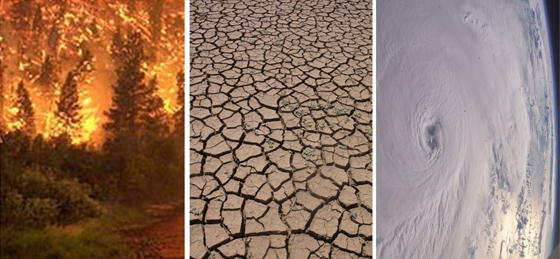
A temperature rise of even a couple of degrees from current temperatures (likely to occur within a few decades at our current level of fossil fuel consumption) would devastate food production, lead to increased extreme weather, and flood low lying areas. Current predictions for the likely increase in temperature by the end of the century range from 3 to over 10 degrees. When you consider that an increase of only 6 degrees (and possibly less if feedback events such as the release of underground methane caused by increased temperatures are included) would spell the end of most life on earth. Most ecosystems would utterly collapse, food production would become impossible in almost all regions of the world, and humanity would be pushed to the brink of extinction.
Even if you don't care about the immense suffering caused as result of inequalities, poverty and an inherently unstable economic system, you can see that not even you can escape the annihilatory environmental effects that will arise from the continuation of our current system!
Immorality - The 'Human Nature' Fallacy
"Moral certainty is always a sign of cultural inferiority.
The more uncivilised the man, the surer he is that he knows precisely
what is right and what is wrong. All human progress, even in morals,
has been the work of men who have doubted the current moral values, not
of men who have whooped them up and tried to enforce them. The truly
civilised man is always sceptical and tolerant, in this field as in all
others. His culture is based on 'I am not too sure.'" - H. L. Mencken
The argument that is probably brought up the most often in the debate of the merits of capitalism is the issue of 'human nature' - that capitalism is the natural outcome of primal human impulses of survival, which includes the accumulation of material goods and the brutal competition with other human beings. Therefore capitalism is the final evolution of human societies, and any other system is impossible because we are intrinsically greedy, exploitative and self-serving.
But this perspective is not based on reality. The earliest human societies (small family and tribal groups) were probably more collaborative than any society since then - they had to be! To survive, prosper and pass on their genetic code they had no choice but to work together in close knit groups, generally with each member taking a roughly equal share. Of course it is a natural human impulse to survive, but it is not natural to do this at the expense of fellow human beings. If it was, humanity would have been unlikely to have survived for very long before people's inability to co-operate lead to them all getting eaten as they slept alone, or the majority not having enough food if one member of the group was hoarding it. In fact, the survival/self-serving instinct is best served through co-operation - you will do far better with a hundred people working with you than by working against a hundred people!
If, in the unlikely situation that the mostly baseless assumptions made by proponents of capitalism about the human condition turn out to be true, what is that to hold us back to our roots? Every major religion for thousands of years has been based on a philosophy that is almost diametrically opposed to that of capitalism; a philosophy of altruism, co-operation and spiritual wealth, compared to the capitalist philosophy of exploitation, competition and material wealth. The vast majority people recognise that greed, selfishness and materialism are negative traits to have, even though many of those people do not act on it. As a species we see that capitalism is morally reprehensible, but we continue to hold on to it. Perhaps it's time we let go.
Ultimately capitalism, specifically its prominent consumerist element, cheapens the human condition and the human experience. Consumerism, through advertisements, media and other sources, tells us that we need 'things' to be happy, so we base our lives on the pursuit of these things. Even though advances in technology have given us the ability to partially or fully automate many tasks, thus decreasing the number of hours that we need to work, people now work longer hours than at any time before, just so they can purchase more things. This is, of course, self-defeating. Material possessions rarely give us long-lasting happiness and satisfaction, even though they may appear to for a time, and by increasing the length for which they work, people are given less time to spend with their friends and families, developing as a person and exploring interests - the things that will really make us happy and fulfilled in our lives.
Can Capitalism be Saved? From all these arguments we can see that capitalism in its corporate-consumerist state can not continue, and should not continue, if we want civilisation to continue in a stable and morally acceptable way (unless you can convince me otherwise in the comments section). Our current system has shown itself to be inefficient, unstable, destructive, unsustainable and morally repugnant, but can capitalism be modified to a more appropriate form? What, if anything, can we learn from the philosophy of capitalism?
What is Right in Capitalism?
There are a small number of elements to capitalism that are probably necessary in a new system. One of these is the importance of hard work, although preferably not for self-gain, but instead for self-fulfilment and helping others. The importance of personal freedom in capitalist philosophy is certainly necessary in a future system that can be considered moral. Aside from these two things, there is precious little that we should take from capitalism in its current form.
Modifying Capitalism Could capitalism be adjusted to a more stable, equal and sustainable form? The pillars of capitalism - profit, private ownership and the accumulation of capital - would suggest no, since these go against the desirable elements that an improved model of capitalism should have. Trying to accommodate these into capitalism would likely have to mean the twisting of its key tenants, rendering it vastly different to its roots - perhaps so different that it is no longer capitalism.
Capitalism is based on negative traits that people may harbour, and relies on the suppression of positive elements of the human psyche, such as compassion, altruism and a desire to work together. If we are to develop a system that fosters these positive traits, I can see no way that it can be achieved using capitalism as a framework.
We can try to patch up the box that is capitalism all we like, but still it will continue to leak its wealth, spelling untold human misery and suffering. The box threatens to burst entirely, destroying all of civilisation in the process. It is about time that we stopped trying to repair the box, and begin constructing a new one, that is strong, well filled and able to respond to changing times, before it is too late.
Towards the Future
"Where there is no vision, there is no hope." - George Washington Carver
What are we to replace the corporate-capitalist system with? Socialism, communism and sometimes fascism are often portrayed as the only alternatives to capitalism, but extraordinary times call for extraordinary thinking, beyond those which has remained mostly static for decades. We live in a world balanced precariously between despair and hope; between self-destruction and revitalisation. The forces of science and technology continue to advance inexorably, presenting new opportunities that would not have been possible even a few decades ago.
Visions of the Future
"The economics of the future is somewhat different. You see, money
doesn’t exist in the 24th century. The acquisition of wealth is no
longer the driving force in our lives. We work to better ourselves and
the rest of humanity." - Captain Jean-Luc Picard
I implore you to, as I have done, envision the future that you want. Spend time reflecting on your life philosophy, the current state of the world and your own experiences, and try to find what you would like the world to look like in a decade, fifty years, a century, or more from now.
I'd like to think that things like no more war or poverty are a given in your vision, but develop your views more, and always be critical of the conclusions you come to, and of course critical of others' conclusions.
In your future, what is it that drives people? What are the priorities of society? What is the role of government, if there should be one at all? What should the economic, political, social, cultural and spiritual apparatuses present to ensure the best quality of life for the highest number of people?
I'll look more at what my vision is in future posts, but it is certainly impossible to come to the conclusion that capitalism, in any form remotely like the current one with the obscenities of widening inequalities, deepening poverty, increasing instability and potential annihilation that goes along with it, will meet the criteria that a fully thought-out vision should, and I challenge you to prove me wrong!
 This is a controversial topic that I have wanted to summarise my thoughts on
for some time, and my answer to the question posed is 'no'. To clarify the
meaning of the title, by 'soldiers' I mean people who fight in an army as part
of their job currently, and by 'not heroes' I mean not possessing the qualities
of a hero by virtue of being a soldier. I will first summarise why soldiers
should not be considered heroes, then tackle the 'pro-hero' arguments, and
finish by discussing the potential dangers of the hero worship of soldiers.
This is a controversial topic that I have wanted to summarise my thoughts on
for some time, and my answer to the question posed is 'no'. To clarify the
meaning of the title, by 'soldiers' I mean people who fight in an army as part
of their job currently, and by 'not heroes' I mean not possessing the qualities
of a hero by virtue of being a soldier. I will first summarise why soldiers
should not be considered heroes, then tackle the 'pro-hero' arguments, and
finish by discussing the potential dangers of the hero worship of soldiers.