"Our lives begin to end the day we become silent about things that matter" - Martin Luther King Jr.

Labels

Showing posts with label Technology. Show all posts

Sunday, 11 November 2012

The Case for Space


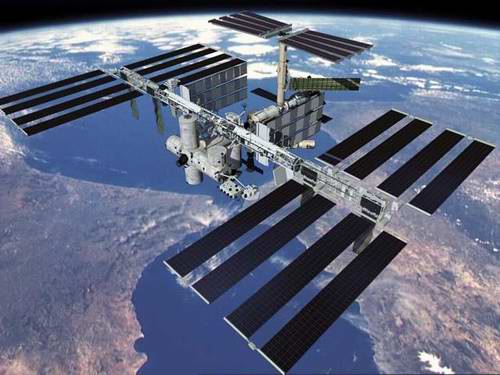
Space exploration is often seen as an excess of Humanity, funded at the expense of more important needs. Surely the 150 billion dollars spent on the International Space Station would have been better used combating poverty, or cancer, or climate change? However, people often don’t look beyond the immediate and the conspicuous elements of space travel, and thus ignore the important effects that space exploration has on civilisation.
For a long time space exploration has perched on the edge of technological know-how. Many people are familiar with the fact that the Moon landing was achieved with less than the computing power of a pocket calculator. The list of technologies that were either developed or improved through the space programme is enormous. A cursory glance at Wikipedia’s ‘NASA spin-off technologies’ page will show you an imposing list of such technologies, including light-emitting diodes (LEDs), radically improved solar energy and structural analysis software. Whilst even these important technologies pale in the face of the many billions that were poured into the Space Race, they cannot be ignored when looking at the value of that funding.

Space exploration is not just about landing people on other planets; it is about putting satellites into orbit, sending unmanned probes to distant reaches of the solar system, and learning more about the Universe we inhabit. The benefits that satellites have brought us are immediately clear – information networks, weather forecasting, monitoring farming, atmospheric studies and so on. An understanding of climate change, a phenomenon that could prove to be the greatest threat humanity has ever faced, would have been immensely more difficult had we not made such concerted efforts to leave the planet. Our ability to communicate would also have been greatly diminished without satellites that can send signals to the other side of the Earth in a fraction of a second.

Sending unmanned probes has improved our knowledge of other planets and other-worldly bodies, and by extension has augmented our understanding of our own planet. By looking at how the climates of planets like Mars and Venus have changed we gain insight on the mechanisms that affect our own. Space-based telescopes have allowed us to peer into the depths of space, showing us a previously hidden Universe that has lent help to our knowledge of physics. Even today space exploration is trying to answer the most important questions that we can ask: Are we alone? Why is there something instead of nothing? What does out future hold? In this respect, space exploration is a necessity for us to satisfy our species’ endless search for knowledge and new frontiers.

Our tentative first steps into space have also had a cultural effect. The heavily publicised major events of space exploration have likely inspired a generation of engineers, scientists and technologists. It was an affirmation of the exciting ideal that anything humanity can imagine, it can achieve; to paraphrase Kennedy, ‘We choose to go to the moon not because it is easy, but because it is hard’. Undoubtedly the earlier stages of the journey into space may have had an even greater effect if it was in the spirit of co-operation, as it is increasingly nowadays, but the direct and indirect effects of the events that captured the entire world’s imagination cannot be understated.

Our decision to beginning, and continue, our forage into space will be crucial to Humanity’s long-term survival. The impact by a large asteroid (or similar apocalyptic event such as nuclear war) is not a matter of if, but when. We will be very glad when that we started when we did, when that time comes. If we had dismissed space exploration as an unnecessary luxury, we would have literally putting all our eggs in one basket. It only needs one rouge comet (or nation!) to put an end to virtually all human life on Earth, and at least now we stand a fighting chance at being able to do something about it.

 
Some of the effects of space travel are not easily tangible. Arguably pictures from space, such as Earthrise (right) or the Hubble Ultra Deep Field (see elsewhere) have given many people a new world-view. To see our small oasis in an endless sea of unforgiving space underlines our need to protect it, and maintain a sense of perspective. In the words of Carl Sagan:

“Look again at that dot. That's here. That's home. That's us. On it everyone you love, everyone you know, everyone you ever heard of, every human being who ever was, lived out their lives. The aggregate of our joy and suffering, thousands of confident religions, ideologies, and economic doctrines, every hunter and forager, every hero and coward, every creator and destroyer of civilization, every king and peasant, every young couple in love, every mother and father, hopeful child, inventor and explorer, every teacher of morals, every corrupt politician, every "superstar," every "supreme leader," every saint and sinner in the history of our species lived there--on a mote of dust suspended in a sunbeam.”


- Daniel

Tuesday, 4 September 2012

Humanity's Best Bits

We live in a world that, at times, can seem cruel and broken, especially with news services than naturally focuses on the negative. Yet, every day there are untold stories of heroism, selflessness and progress that few will ever hear of, and countless more hidden in the mists of time. Rising above all these are a group of major events that everyone knows of - humanity's greatest achievements. From the Moon Landings to the Human Genome Project, these are some things so important that their effects go far beyond the event itself. In no particular order, and likely with many that should justifiably be on this list, I'm going to look at what I believe are humanity's best bits (with an obvious science/technology slant).


Space Exploration

The clichéd ultimate achievement is the Moon landing; undoubtedly reflecting the pinnacle of perseverance and technical know-how, it is only one of many milestones on our species' journey beyond our home planet. The first man-made object to be put into Earth orbit, the first man in space, the first landing of probe on Mars, and very recently the crossing of Voyager 1 into interstellar space are all accomplishments comparable to the manned landing in 1969.

Space exploration is the highest expression of humanity's innate drive to explore. Arguably, our adaptability to new environments and desire to spread across the planet, is one of the key elements of our psyche that makes us so unique and successful. From the first exodus from Africa, to the colonisation of the Americas, human history is filled with expansionary tendencies. Having explored all but the deepest recesses of our planet's surface, the move to space seems like the natural next step.

Some say that space exploration is a waste of resources, but I disagree. Aside from the enormous benefits of satellites that measure our planet's climate, allow us to communicate near-instantaneously from opposite sides of the world, and to peer to the very edge of the universe, space technology has had many offshoots that are inextricably woven into the fabric of human life.

In time, we will be glad that we began the move into space when we did. Our planet is threatened by countless events, both internal and foreign. Should an asteroid on a collision course with Earth be discovered tomorrow, and forecast to hit within 10 years, we would be more than hard-pressed to put up any resistance at all had we not yet bothered to begin our journey into space. The coming of such an asteroid is only a matter of time, and when it comes we should be prepared thanks to the leaps we have already made. Similarly, should a different apocalyptic event arise sometime in the next century or so, it is highly likely that we will have established some sort of permanent settlement on other bodies in our solar system, and that should civilisation on Earth be destroyed, humanity will continue.

While space missions are usually done under the name of a particular country, they are usually supported by an enormous team of people from all over the world, making space exploration a profoundly international endeavour. Although nationalism was heavily intertwined with exploration during the 'space race', more recently it is often considered as more of a collaborative enterprise, epitomised by the most expensive man-made object ever to exist, the International Space Station. The view of our planet from space has ignited a new view of the world, with perspective shifting from a national to planetary level, as summarised by astronaut Donald Williams: "For those who have seen the Earth from space, and for the hundreds and perhaps thousands more who will, the experience most certainly changes your perspective. The things that we share in our world are far more valuable than those which divide us." This can only accelerate as journeying to space becomes more commonplace, and eventually available to not only astronauts the mega-rich.


Eradication of Smallpox

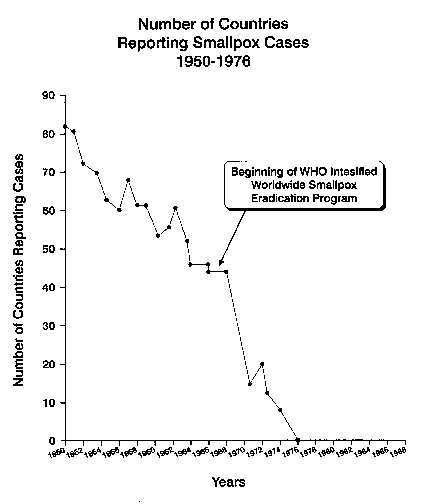
Over the 20th century, Smallpox killed between 300 and 500 million people - several times more than the total killed by both World Wars combined. Since the early 19th century, humanity has made efforts to wipe this scourge, which leaves many who survive it disfigured, from existence. Only in 1959, following a recommendation from the USSR's deputy health of health, was a concerted effort made to complete the job, eradicating what remained of it mostly in developing countries. In 1977 the last person was naturally infected, and two years later Smallpox was declared extinct, apart from a few strains remaining in storage possessed by the USA and USSR.

The eradication of Smallpox gave new hope to the similar extermination of diseases, including Polio and Malaria. For once we managed to wipe out a species that we actually wanted rid of (as opposed to the many hundreds, and possibly thousands that have become extinct due to our destruction of the natural environment) and saved many millions of lives as a result. Interestingly, the eradication Smallpox passed with little celebration - surprising for an event of such importance.


The Internet

The internet has come to dominate all spheres of civilization, from education and business, to social networking and journalism. The culmination of developments in communicative technology over the past century, it provided a place at which most human knowledge can be stored and accessed, and a hub for all types of media and art. It's true potential is only just being realised, and is likely to continue to increase in its effect on society and use in all walks of life.

The rise of the internet has lead to the creation of new dynamics, including instant messaging, social networking, memes (the funny pictures, and not the unit of cultural evolution), blogging (as you can see!) and so on. Arguably, our lives have been enriched more by the internet than by any other technological development, with the obvious exception of medical advancements. The achievement that is the internet is clearly not its creation alone, but also its populating with billion upon billion of web pages by many millions of people from every country in the world.


The Large Hadron Collider (and other awesome machines)

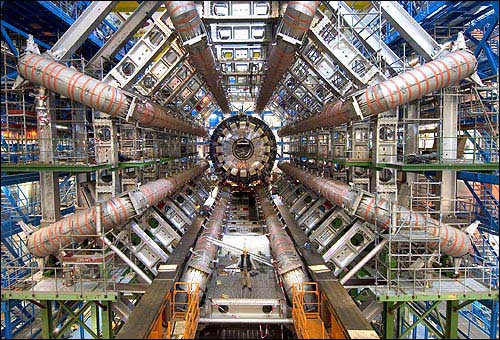
I'm lumping in machines like the first nuclear reactor (despite it's use in the first nuclear weapons), International Thermonuclear Experimental Reactor (ITER), National Ignition Facility (NIF) and various other particle smashers. The benefits of nuclear reactors are clear, providing clean (or at least somewhat cleaner than fossil fuels) energy with very little material, and the potential benefits of fusion reactors are even greater.

Many people object to the pure research that machines such as the LHC are involved in, on the grounds that it is costs an enormous amount ($4 billion) for no tangible benefit. This isn't necessarily true, as the construction of operating of the LHC has created and maintained jobs, and may have unexpected implications in the future. Without pure research there would be no applied research, and therefore no technology, so it is unreasonable to object to pure research. It is also difficult to establish whether a particular pure research project could produce anything directly beneficial in time, so the best course seems to me continuing pure research, if not only to satisfy human curiosity.

Note also that the cost of the LHC is less than what the world spends on it's militaries PER DAY - if there's a drain of resources that people should be complaining about, that is it!

These great machines are important not only for their use, but also for what they represent: the pinnacle of engineering and technical knowledge. Each is comprised of many millions of parts, precision engineered and fitted together to produce something that carries out something incredible, be it splitting atoms or smashing them together. They truly are testaments to our ingenuity and curiosity.


Artificial Intelligence

Obviously (at the time of writing) this isn't something that has been created yet, and is not likely to very many years. This would  be, in my opinion, the single greatest development that humanity could make, both past and future. The creation of a true AI would be revolutionary directly in neurology, and indirectly in everything from philosophy to gaming. As I've suggested earlier, AI could spark an unprecedented shift in technology, and society as a whole.

Interestingly, now that I've got to the end of the list (remember that this is not exhaustive) I noticed they tie in chronologically:

Space exploration: 1957 (Sputnik) onwards
Smallpox eradication: 1979
The internet: 1982
LHC: 2008
Arificial intelligence: 20?? (being a techno-optimist)


What does it mean?

You may have noticed a theme running through this article - that all of these achievements were international in scope. The point I would like to make is that far greater progress can be made through co-operation than competition, and that to tackle the great problems of our time necessitates greater collaboration and unity. Be proud of what our species has accomplished, and look forward to what it will achieve in the future!


Thursday, 9 August 2012

Amnesia: The Dark Descent - The Art of Fear


I recently managed to pluck up enough courage to complete the horror game, 'Amnesia: The Dark Descent'. I've seen some horrible things, and gone to some dark places, but it's finally over... This post is half-review, and half looking at what makes people scared (which Amnesia does exceptionally well). There are *MINOR SPOILERS* in the article, so if you want to play Amnesia with no prior knowledge at all, just skip to the conclusion now! If you don't mind, I'll put the spoiler alert on paragraphs that give away things in the game that would better be left to experience yourself.


About Amnesia

First things first, Amnesia is a horror game developed by Frictional Games. It follows the story of protagonist, Daniel (BONUS!), after he wakes up the suspiciously empty castle of Brennenburg, muttering about his name and rolling around the floor a little. This is the only information that the game gives you at the beginning, initiating fear immediately through the sense of mystery and feelings of vulnerability.

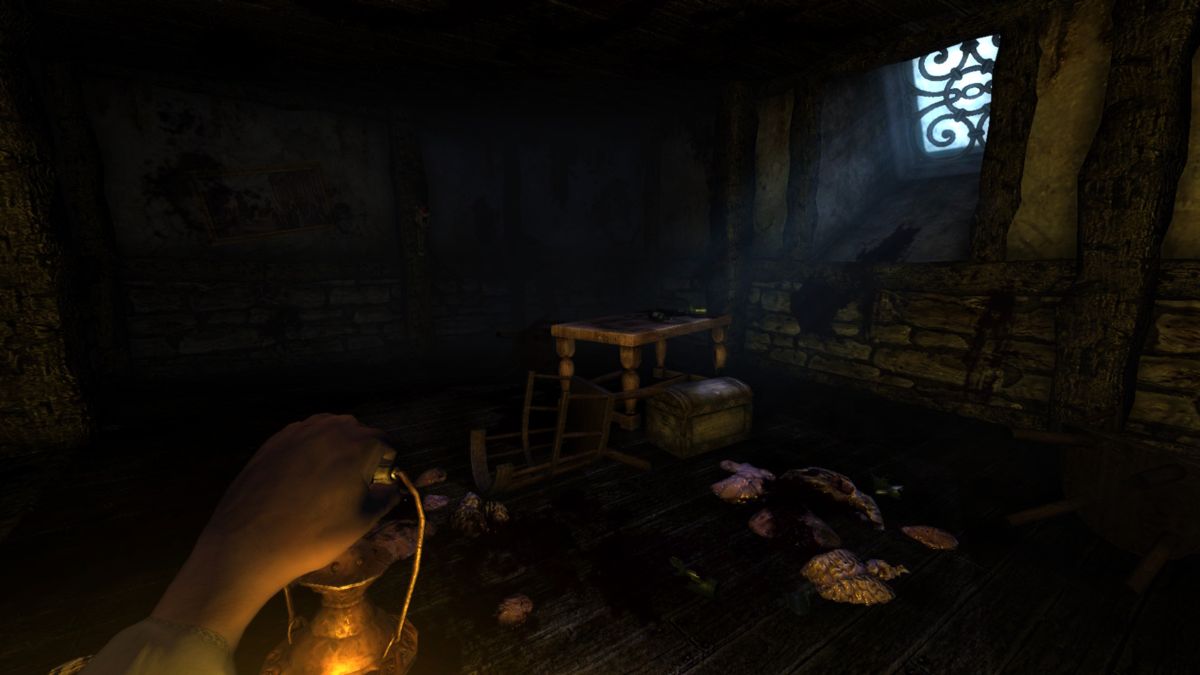
You quickly find items called 'tinderboxes', which you can use to light most light sources in the game. Soon after you find the only equipable item in the game, the lantern, which has a finite fuel supply that can only be replaced by finding even more limited oil flasks. You are forced to actively conserve tinderboxes and oil, lest you be left in darkness, which will drain your sanity (Daniel suffers from nyctophobia and necrophobia - not great in a castle filled with both darkness and corpses). If you end up on low sanity because you've spent to long in darkness, or see too many 'unsettling events', your vision begins to go blurred, and you will eventually collapse onto the ground, crawling. Again, not fantastic when you're about to get eaten by a hungry looking monster with a jaw as wide as its arm is long.
Even better, you can do absolutely nothing about these monsters, other than hide, run or simply avoid them altogether. No guns. No swords. You can't even punch the blasted things! You are completely defenceless, leading to paranoia and a lot of hiding in corners. Don't try negotiating with them, or offering shiny trinkets that you've gathered on your journey - it just makes that angrier. Looking at the things will drain your sanity further, and will cause your vision to become distorted (see picture).

The game is comprised of 3 main elements - avoiding/running from/crying-in-corners-until-they-pass monsters, completing puzzles and exploring the castle as you descend deeper and deeper through its many levels. That should give a good overview of the game, so I'll now go to what makes it quite so scary.


Generating Fear

"I don't see what's so scary about it? It's all just on a screen so it can't hurt you."
- My sister

Oh, if only it were so simple! Yes, perhaps if you just threw caution to the wind and ran through the entire game fearlessly, it might not be so scary, but if you actually want to experience it fully you need to do what it says at the start (play in the dark, don't expect to 'win' and let yourself enter the world of Amnesia.) Instead of rambling about what makes Amnesia scary, I'll instead examine the three components (in ascending order) that I found to be the most important in generating the extreme fear that I, and most who play it, felt.

The first of these is the plot, including the scripting of certain events and monster appearances. The plot itself is very dark, as only revealed incrementally mostly through diary extracts you find lying around. There are numerous references to torture, murder and kidnapping, with the descriptions and flashbacks becoming more and more vivid as the game progresses. I found this to be particularly draining, especially the very disturbing 'torture rooms' areas in the late-game, bathed in an eery red glow and rapidly draining your sanity.

The scripting of events is very intelligently done - there are only a few 'jump-out' scary moments, and these are done with such rarity and built up so well that they are genuinely terrifying (I literally started flailing during one of them...) This is in stark contrast to games that rely almost entirely on this type of scare (Dead Space, etc.), and the novelty quickly wears thin, with them becoming predictable. The main horror drive of the game comes from careful pacing, and careful placement of monsters and events that leave you afraid to turn the corner, or take a few steps down a darkened corridor. There is, in fact, only a relatively small number of times that you will encounter monsters, and in many of these the monsters present no real threat. The strength of the game is that it keeps you guessing, and trying to predict where there will be monsters, and then surprising you when they're not around the suspicious-looking corner.

*SPOILER PARAGRAPH* One thing that I noticed to be very powerful was the revisiting of previous areas, which act as 'hubs' connecting to several areas. This is done in many games become it gives the player a sense of reassurance and achievement if they have completed an objective before revisiting, but Amnesia turns this on its head, often having the hub transformed (an example is a nice fountain which fills with blood and has a corpse lying in it), or mostly destroyed by the supernatural being known as 'The Shadow'. A similar device used is the destruction of the feeling of safety in certain areas. Fairly early on in the game, you reach what used to be your bedroom, which comprises of three small well-lit (a blessing in Amnesia!) rooms. You feel like you could just spend a few minutes recovering from stumbling through dark corridors with the sound of monsters around you, until you here groaning and something beating down the door. Although this encounter isn't particularly dangerous (you can just hide in your trusty closet until it finishes messing up your room), it certainly made me doubt the safety of even the nice areas of Amnesia, destroying the last places of refuge in the game for me.

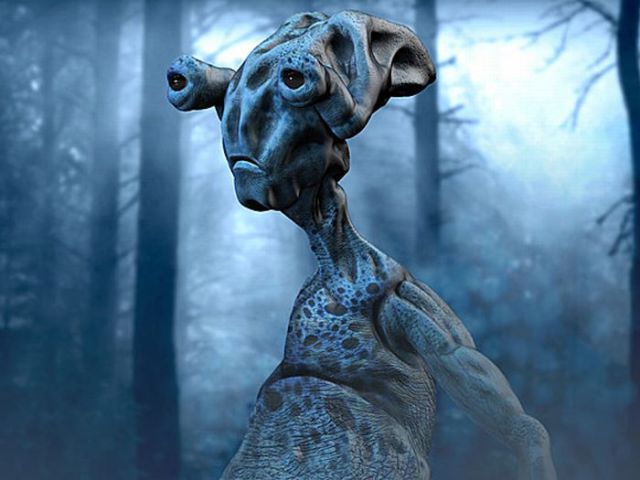
On to the second of the components; the monsters themselves. The design of the monsters are outstanding for the purpose of scaring the player. Importantly, they are recognisable as human, but are horrifically deformed. Although I can't speak for everyone, I literally wanted to avoid looking at them, not only to conserve my sanity and to avoid them seeing me, but because they are actually scary in their own right. Not only their appearance, but their shuffling movements, their nightmare-haunting moans, and even the ominous music that accompanies them, are terrifying.

The formula for monster encounters is also clever - you look at them, they usually look at you, then you must run and hide with them hot on your heels. The adrenalin rush of some of these chases can be overwhelming, and can often warrant taking a break to calm back down (or at least they did for me, as easily scared as I am.) There are no monsters jumping out of cupboards, or similar cheap scares, and you will often see the monster before they see you, if you're fortunate.

The final, and most potent element of the game, for me, may be surprising - the sound. From the dreaded 'chase music' to the haunted cries that echo around the depths of the castle, the sounds of the game are what really make the atmosphere. What was that? It sounded like footsteps. Perhaps it's through that door. Or maybe it's above me. The sounds keeps you guessing and worrying, and the sound of wind through an opening in the ceiling can still make you jump if you're already put on edge.

Some people have suggested that you could remove the monsters to make the fear of the game more manageable (many people do struggle to play Amnesia for more than an hour before giving in), but I think that the simple removal of the background noise and music would be enough to almost neutralise the fear of the game, perhaps leaving it almost comical. I was unable to find the willpower to use headphones as suggested, but I am sure that it would have made much of the game utterly unbearable.

Notable mentions go the lighting, which is not excessive, nor is everything shrouded in darkness, to the use of the 'sanity meter' to provide additional impetus to stay in the light and avoid monsters, and also to physical design of levels. The claustrophobic, mazing passages of the prison, or the dank, water-filled chambers of the cistern, were enough to stop you in your tracks for a while, until you work out the safest path and second-guess where monsters could be.


Conclusion

Amnesia is a masterpiece of the horror genre, and perhaps even of the gaming world. It pushes almost every fear button that our species has - the dark, human-like monsters, death, torture, vulnerability, running from an unyielding enemy, the unknown and even the odd spider. What I've said here only scratches the surface of Amnesia, and you will not be left unsatisfied if you decide to play it in the way that it suggests. The pure dread that I felt as I wandered down those dark corridors clutching my lantern, almost out of oil, is unmatched by any other game I've played, film I've watched or book I've read.

Try it out for yourself! Or are you too much of a chicken? ;-)


- Daniel

Saturday, 30 June 2012

SETI: The Ultimate Search - Part 1

Well, it's been while since I last posted here, due to exams and such, but I should hopefully be able to write more frequently from now on. As the title suggests, this is about SETI (the search for extra-terrestrial intelligence if you really prefer), its worth, and its implications.


Where is Everebody?

SETI is what it says on the tin - the searching of the universe for other intelligent species like ourselves (at least some of the time), although not necessarily a lot like ourselves. Limitations on our current technology clearly prevent us from partaking in this search in person, so we've had to resort to listening for, and sending out, signals from and to outer space. We should first examine the likelihood that anyone is actually out there.

The good news is that someone has already beaten us to it, namely Frank Drake, with his formula know as the Drake equation, with which the number of communicating extra-terrestrial civilization can be estimated. The bad news is that the equation has seven variables, of which only two are known with any certainty, although we have some idea of the values of a couple of others. Here it is:


N here is the number of detectable extra-terrestrial civilizations in our galaxy, the Milky Way. Let's take each variable in turn, which become estimated with less and less certainty as you go on.

R, the average rate of star formation, is the one variable that we can be sure is about right. In our galaxy, around seven stars are formed each Earth year; no mean feat considering that each one is likely to last for many billions of years.

fp , the fraction of good stars (meaning stars that aren't pathetic white dwarfs, or over-sized giants) varies from around 20% to almost 100%. For the sake of neutrality, I'll go for the value in the middle: 60%.

ne, the average number of planets (or possibly moons, *ehem* Avatar *ehem*) that are capable of supporting life in those systems that have any planets at all, is a value that is only just now being investigated. Initial estimate suggest that perhaps around 10% of planets are capable of supporting life. If we take our own solar system as a rough guide, that works out to around one planet capable of supporting life. As a sample size of 1 isn't great, I'm going to use the, perhaps conservative, figure of an average of 0.2 earth-like planets per star.

fl , the fraction of those planets where life actually develops. For the purpose of not resorting to pure guesswork already, I'll use the figure of 0.2, based on the time that it took for life to develop on Earth.

fi , the fraction of planets on which life develops where a species evolves intelligence. I'm going to use an educated guess of 0.05, since, given enough time, the evolution of intelligence seems likely, but by no means certain.

fc , the fraction of those species that possess, and are using, communications technology. Again, I'm going to use the figure of 0.1, based on the length of time that we have been using communication technologies as a fraction of our total length of existence, past and future, and the possibility that some intelligent species struggle to form a civilization.

L, the length of the 'communicative phase', which is likely to correspond to the length that the civilization exists. This is an interesting variable which warrants longer discussion. There have been several points in our recent history at which we have come close to the end of civilization, all of which have been due to the threat of nuclear weapons, and indeed our continued future is threatened by climate change. However, it isn't as simple as working how long, on average, it takes for someone to accidentally detonate a nuclear weapon, or how long a species can keep their climate stable. This is because a civilization even a little more advanced than ours would be able to establish colonies on nearby planets and moons, and given a little more time, on the planets of other stars. When a species reaches this stage of development, they could become essentially immortal, even if their home star died (they could simply migrate to another). Therefore, I'm going to tentatively suggest an average of 1,000,000 years; still a tiny fraction of the total age of the universe.

And now, the moment of truth:

(7 x 0.6 x 0.2 x 0.2 x 0.05 x 0.1 x 1000000) - 1 [us!] = 839 detectable civilizations in our galaxy, and therefore about 80 trillion in our universe. But where on Earth (well, not) are they?


The Fermi Paradox

From the above calculation, it would seem that our galaxy, and universe, are abuzz with life. Unless you happen to believe the UFO nuts, you might have noticed that we haven't seen much of these 800-something civilizations, and don't even have a smidgen of evidence. This apparent contradiction is known as the Fermi Paradox.

One way to resolve the paradox is glaringly obvious - the calculation seems to be really quite naff, and it is indeed! If we change the values for the percentage of life-supporting planets that develop life from 0.2 to 0.05, and the fraction of intelligent species using communicative technologies from 0.1 to 0.01 (these change are not at all unreasonable, and would still be considered very optimistic by many), we now come to a figure of just 21. With just a little more adjustment and we can come to a figure of 1 or less.

There are many other explanations that have been proposed, including that a majority of civilizations destroy themselves too quickly (although this has already been taken into account in the equation), that most species have a policy of non-interference, much like the 'Prime Directive' of Star Trek, or simply that they don't want to communicate.


First Contact

Let's imagine that somewhere amongst the hundreds of billions of stars of the Milky Way, there is an intelligent species other than our own. How might contact happen, and what would be the consequences?

As suggested earlier, it's likely that initial contact would occur via communication technology; either with us receiving a message from outer space, or with them receiving one of our messages, such as the Arecibo message. You might be wondering how this is going to work, since we are certain to use utterly different language. Instead of our own languages, we have used the universal languages, of mathematics and science, which (probably) are the same for all intelligent beings.

However, this method of communication is severely limited by the many tens, or hundreds, of years that it would take for a reply to travel back across the vast expanses of space. Regardless, this is the only line of inquiry pursued by SETI organisations.

The most interesting form of contact, popularised in countless books, films and games, is that of direct contact; as in aliens visiting Earth in person. You many have noticed that a theme running through the portrayal of direct contact in these media sources is that this first contact doesn't often end well for Humanity.

In my opinion, it is unlikely that this would be the reaction of another civilisation to out own. For a species to survive its technological adolescence, it cannot have been so bellicose that it would attack other species on sight. A more likely response would be similar to our own; that they've just discovered another intelligent species, perhaps the first they have ever encountered, and that annihilation is not the best course of action.

What might be the effect of first contact on our own species and society? You'll have to wait for part 2 to find out...


- Daniel

Saturday, 31 December 2011

The 'Technological Singularity' and the Rise of the Machine

To get my blog rolling, I'm writing a introductory piece for each of the 6 topics, starting with technology (don't get too excited), specifically the 'technological singularity', as it covers most important elements and aspects of technology.

What is the technological singularity?

"Where the ENIAC is equipped with 18,000 vacuum tubes and weighs 30 tons, computers in the future may have only 1,000 vacuum tubes and weigh only 1 1/2 tons."


- Anon, 'Popular Mechanics', March, 1949

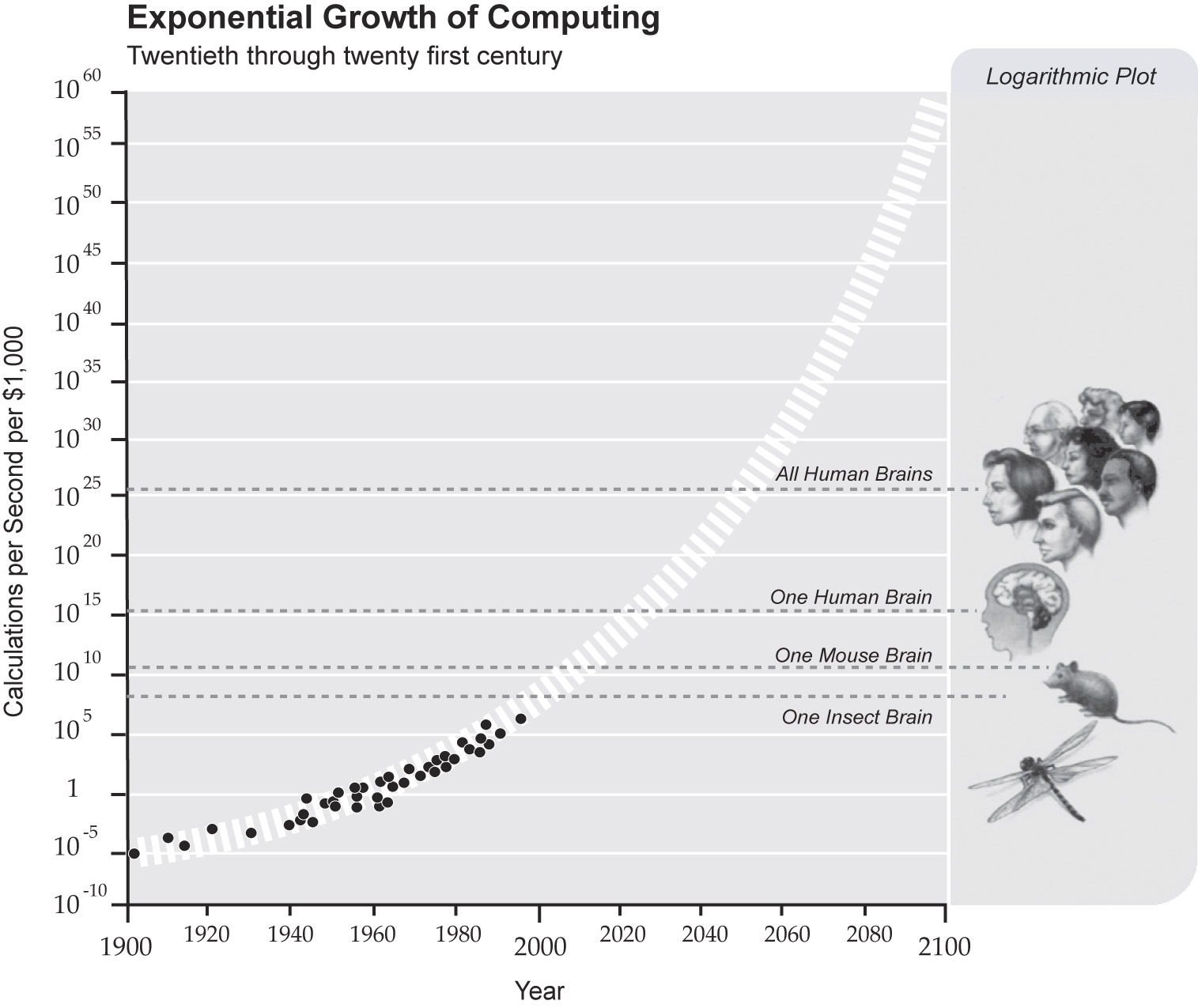
Most people are familiar with Moore's law, that computer chip performance will double every 18-24 months, in some form or another, but few reflect on the implications of this. If we assume that current trends continue, we can extrapolate a few rough predictions:

2020 - A personal computer with the processing power of the human brain will be in existence

2045 - A personal computer with the processing power of every human brain on the planet will be in existence

The inventor and futurist Ray Kurzweil has postulated that at some point in the future, a technological 'singularity' will occur, similar to the singularity at the centre of a black hole predicted by physics. This is the point at which technological progress, if plotted on a graph, essentially becomes a vertical line. But how would this suddenly occur?

Kurzweil predicts that once a computer is created with the processing power of the human brain (the hardware of the brain), it is possible to program the computer to think like we do by replicating the neuronal network in our own brains into the circuitry of the computer (the software of the brain). We then have a computer that, for all intents and purposes, is the same as our own brains. Would it be able to talk to us, feel, and think original as we do? Probably, yes. But would it be conscious? Would it be aware of its own existence? Well that's a topic for another day...

Now, imagine that a year or two after this first computer 'brain' is created, computer have again roughly doubled in power. A second computer is now created, but this one is twice as powerful as our own brain. This gives it twice the ability to reason, to think originally, to imagine and to create. It would be able to make new scientific discoveries, create new technologies or improve existing ones, and most importantly improve itself twice as well as a human can. We might then leave the computer to build a third 'brain' a little later which is even more capable of improving upon itself, and so on.

This becomes a self-reinforcing loop, with greater and greater progress made with shorter and shorter gaps. Within perhaps only a few months more progress is made than in the last 100 years. Within as little as a few years the ultimate potential of matter to compute (which is about 10^42 operations per second for 1kg of matter - 10 trillion times more powerful than all human brains on earth!) could be reached.


Whence singularity?

"You will know the Singularity is coming when you have a million e-mails in your in-box"
- Ray Kurzweil, 'The Singularity is Near'

Of course this might never happen, or not for thousands of years. There could be some fundamental problem in mapping the network of neurons into a computer, or there could be some currently unknown, unique element to our brains that cannot be replicated in a machine, or we may simply end up destroying ourselves before computers can become powerful enough (more likely than you think...)

But, if it is possible, the estimated time of the technological singularity varies. Ray Kurzweil puts the year as 2045, others put it earlier and some later. Personally, I think Kurzweil's got it about right (although I am a little sceptical that the singularity will even happen). Even if there are major problems in achieving the software of the human brain, the hardware should already be more than good enough by this time.


So what?

"Two billion years ago, our ancestors were microbes; a half-billion years ago, fish, a hundred million years ago, something like mice; then million years ago, arboreal apes; and a million years ago, proto-humans puzzling out the taming of fire. Our evolutionary lineage is marked by mastery of change. In our time, the pace is quickening."
- Carl Sagan, 'Pale Blue Dot: A Vision of the Human Future in Space'


So we end up with more and more powerful computer, but what use is that? (apart from letting you run Crysis at 100FPS [I bet no one got that joke...]) Well, as I hinted at earlier, computers aren't just good at making better computers, but can allow progress in every field of science and technology - genetics, nanotechnology, robotics, medicine, space exploration, food and energy production, and countless more. the singularity would be the defining point in the whole of human history, after which everything will be different. Just to give a handful of the technologies that could rapidly develop:

- Nanobots (robots on the nanoscopic scale) that can patrol the body to destroy pathogens and repair damaged cells
- Advances in propulsion that would allow interstellar travel
- Full immersion virtual reality indistinguishable from real-life
- Advances in genetics and medicine that could allow you to prolong your life for hundreds of years
- Technologies that could reverse environmental damage, end poverty and  provide a more than comfortable lifestyle for every human being

Perhaps the most important development, and the one that Ray Kurzweil sees as necessary, is the merger of humanity with technology. He argues that in order to even comprehend the immense change caused by the singularity, humans must amplify their own intelligence with that of the computer, even up to the point of 'uploading' your mind into a computer. This sounds like a scary prospect for most (including myself to an extent!), but would allow immortality to all extents and purposes.

It is well worth pondering the technological singularity - whether you think there is any chance of it occurring in the foreseeable future, and its implications on your life and view of the world.


The dangers of technology

"I think that their flight from and hatred of technology is self-defeating. The Buddha rests quite as comfortably in the circuits of a digital computer of the gears of a cycle transmission as he does at the top of a mountain or in the petals of a flower. To think otherwise is to demean the Buddha - which is to demean oneself."
- Robert M. Pirsig, 'Zen and the Art of Motorcycle Maintenance'

There are a plethora of dangers from technology, many of them existential. Already we are able to wipe out most of life on the planet with nuclear weapons, but the technology of the future could give us more efficient methods. Nanobots could be programmed to replicate indefinitely, consuming the entire planet, along with ourselves in the infamous 'grey goo' scenario (click the link if you want a good scare). Deadly, untreatable viruses could be engineered to wipe out large portions of humanity. There's always the danger of technology popularised in the 'Terminator' series, of a malicious artificial intelligence developing  intent on the destruction of mankind, but this is unlikely since the computer would be based on our own brain, and most of us don't really want to utterly destroy our own species (if you do, please seek help).

There is also a fair chance of the emergence of a violent, unscrupulous neo-luddite or anarcho-primitivist movement, opposed to the advance of science and technology, and advocating a return to a 'simpler' way of living. Perhaps through the ironic use of highly destructive technology they might carry out devastating acts of terrorism to further their cause.

Finally there is perhaps the greatest danger of the exponential rise of the machines. Do, by allowing technology to do everything for us, and by becoming drawn into the world of the computer, we lose something of what makes us humans. Might we become to technology what technology is currently to us - in other words, the transition from a world of humans that happens to contain machines, to a world of machines that happens to contain humans.

Conclusion

"The most common of all follies is to believe passionately in the palpably not true"
- H. L. Mencken

Ultimately, the singularity might happen in 20 years, in a thousands years or never at all. Whichever turns out to be true, it is important that we do not become complacent that it will happen and negate the world and its people today, safe in the knowledge that technology will save us all in time. It is equally important that we do not assume that the singularity will not occur, and fail to prepare ourselves and society for the profound effects of rapidly progressing technology, much of which may pose existential threats to our species.

Well a 600-page book could be written about the singularity, and in fact in has. If you're interested in anything brought up here, I highly recommend Ray Kurzweil's 'The Singularity is Near'. Some of it is heavy reading, but it's well worth it. I hope you've enjoyed the first non-introductory post written by myself, and would be delighted to hear any criticisms you have of the format or content of my posts.


- Daniel

Thursday, 29 December 2011

Introduction

So, this is my blog. I thought I should probably give a little introduction to myself, and to the blog.

As you can see from my personal information to the right, I'm a sixth-form student living in the UK, with a keen interest in Science, Technology, Ethics, Philosophy, Politics and Sociology (S.T.E.P.P.S, if you hadn't worked it out yet). I study maths, biology, physics and chemistry for AS level, and hope to go into medicine after leaving school. So that no one reading this is under any illusions, I'm a humanist and a socialist (deal with it!) Now I'll give a introduction to the different topics covered by my blog:

Science: Science (from Latin scientia, meaning "knowledge") is a systematic enterprise that builds and organizes knowledge in the form of testable explanations and predictions about the universe (shameless Wikipedia copying and pasting, I know). But there's more to science than that.  It is, as far as we know, the best tool for understanding everything in our universe, from the quark to the galaxies, and from the virus to that most wonderous of things; the human brain. Science is the basis of almost everything that we take for granted in our technical civilization, from light bulbs to the space shuttle. Without a doubt, science is the most important element of our humanity - the drive to discover, to explore and to better ourselves.


Technology: Technology, in short, is the application of science to design, construct and use tools (of widely varying complexity) to perform a specific function. When I talk about technology, I don't mean the gadgets that various companies churn out (ehem... ipods, iphones...) that add little to our lives (apart from fun of course!), but the technology that can help us to grow food, to travel around our planet in a matter hours, or to explore the universe. I'll look at the technology that really adds something to our society, and especially important emerging fields of technology, such as nanotechnology and the development of artificial intelligence.

Ethics: Ethics is a branch of philosophy that is used to decide what is considered 'moral' or accpetable to do. It's a wide-ranging topic, covering issues from justice and crime to animal rights and medical ethics.

Philosophy: Philosophy is, as I like to think it, the waiting room of science. It is the place for questions that we can not yet answer using our preferred method, science, but that must wait for perhaps hundred of years, or may never be fully answered. It's the place of the really big questions that make your head hurt if you think too long about them, like "What is the meaning of life?" (other than 42 [haha...]) or "Why are you you?" Philosophy has evolved considerably from its roots millenia ago, and has narrowed somewhat, as parts of it have moved out of its own realm, and into the realm of science. However, it still has many crucial, unanswered questions that are well worth considering.

Politics: *Yawn!* Yes, politics can be boring, espeically in our two-party state, vote-every-four-years media circus, where all the parties are continually at eachothers throats about everything. Accordingly, I'll try not to look at every tiny decision that various governments make, but more at the interesting trends in politics, such as the sudden rise of the far right, or what the global economy might look like after (and if!) it begins to recover.

Sociology: This is the one that not as many people have heard of. Sociology is, in short, the scientific study of society. This makes it overlap significantly with the other five topics, making it of particular interest to me. It deals with issues such as war, nationalism, racism and why no one likes gingers (no offence). I'll explore events, such as the summer riots, as well as long term trends, such as the decline of religion, especially in developed countries.

Other: I'll probably end up sticking in the odd book, film or game review, anything interesting that happens in my life (there really isn't much, trust me) or whatever else I feel like writing about.


Well, that's an introduction. If you'd like any more information about the blog,  would like to make any suggestions or would like to contribute an article, just comment (and please don't be too harsh on me - this is my first ever blog post...)

Also, apologies for the labels at the top being out of order. It won't let me arrange them as I want... If anyone knows how to sort them I'd be grateful for some advice.


-  Daniel