"Our lives begin to end the day we become silent about things that matter" - Martin Luther King Jr.

Labels

Showing posts with label Science. Show all posts

Sunday, 11 November 2012

Rationing and Rationality in the Health Service


The rationing of health provisions is something that garners considerable controversy, so I felt it would be worthwhile to go into it in more detail.

As you’ll know, the NHS is a publicly funded health provider, with finite resources to treat and care for patients. However, if the very best interventions were used for every patient, the NHS would need many times the funding it currently receives. As a result, something has to give, and certain drugs, procedures and care elements must be withheld to stay within budget. The billion-pound question is how the service should be rationed – what should be provided, and to whom.

Intuitively we might be lead to a simple cost to benefit ratio system. Each treatment could have the years of life, or better still years of life adjusted for quality, compared with its cost. This could give a simple value of the cost per year of healthy life. However, it cannot be so simple, in part because the use of one treatment may in time lead to far more expensive care for an illness in later life, such as dementia. A doctor I shadowed during the Summer actually suggested that, if the NHS wanted to save money, they should encourage people to smoke so that people died from acute rather than chronic diseases.

Ignoring the indirect effects for now, here’s an example: A Primary Care Trust (or soon to be Clinical Commissioning Group) has a portion of its funding left to spend, and has two options. It can provide statins to all those with moderately raised cholesterol levels thus reducing the risk of vascular or cardiac diseases slightly for each individual, or artificial dialysis for all those in renal failure, which is clearly saving lives directly.  Both cost the same, but spending the money on providing statins has a cost per healthy year of, say, £10,000, whereas the figure for dialysis is £20,000. This situation is simplistic and ignores the side effects of both, and the figures are made up but not far from reality. In this context ‘Statins’ could be replaced with any risk-reducing, preventative or early diagnostic measure, and ‘dialysis’ with any direct intervention with a greater cost to benefit ratio.

If we were only to use a simple ratio we would consign those in renal failure to certain death in order that a much larger number of people will have only a slightly reduced risk of disease because the net benefit is greater if we provide statins. However, this seems intuitively wrong to us, and the potential recipients of the statins would likely prefer that the money be spent on providing dialysis rather than giving them an insignificant reduction in personal risk.

This is known as the ‘rule of rescue’, that we see ourselves as having an ethical prerogative to save an identifiable person, even if the resources put into it would be better used on what could be termed ‘statistical’ people. The term comes from the enormous resources that are often put into finding a missing person, or rescuing one in danger. You may have noticed that, to quite an extent, this is how the NHS functions, with things like intensive care units, expensive ‘last-ditch’ cancer drugs, and arguably many surgical procedures. In other words, prioritising care to people who require it immediately at the expense of people who could have their risk of disease reduced. The fact remains that those ‘statistics’ are still people in need of healthcare, and that their eventual illness and death is just as real as the individual’s. The rule also acts the other way - patients believe, rightly or wrongly, that they are entitled to certain treatments. This can be very difficult for doctors if the expected treatment is not within guidelines.

The ethical dilemma of a cost to benefit ratio is deepened when we consider groups such as the users of tobacco, the overweight, the elderly and other at-risk groups. It seems reasonable that the future prospect of life, which is often limited for, say, the elderly, should also be factored into healthcare rationing decisions. The practical implication of this would be that that the prior-mentioned groups may have certain treatments withheld on the grounds that they will get less benefit than a young, healthy person would. This runs against our intuitions about the need for equality in healthcare provision, and again for providing care to those who need it immediately.

In an ideal world we should want to help all groups of people, be they identifiable individuals or ‘statistics’, and be they young or old, but we often aren’t able to do so. In these times of economic trouble, perhaps we have an imperative to move from the ‘rule of rescue’ to a more holistic provision of healthcare which has greater emphasis on prevention and early diagnosis, lest the service run into such financial difficulties that it cannot adequately provide either. By the way, this is not a manifesto to stop dialysis or shut down ICUs, but simply something to get people thinking about how healthcare is rationed, and whether some parts of the NHS may have become too bloated at the expense of simpler preventative intervention.

So, do you agree with my tentative conclusion? Do we base too much of our health policy on the rule of rescue at the expense of healthcare? Where should we draw the line between expenditure on public health and on treatment?


- Daniel

The Case for Space


Space exploration is often seen as an excess of Humanity, funded at the expense of more important needs. Surely the 150 billion dollars spent on the International Space Station would have been better used combating poverty, or cancer, or climate change? However, people often don’t look beyond the immediate and the conspicuous elements of space travel, and thus ignore the important effects that space exploration has on civilisation.

For a long time space exploration has perched on the edge of technological know-how. Many people are familiar with the fact that the Moon landing was achieved with less than the computing power of a pocket calculator. The list of technologies that were either developed or improved through the space programme is enormous. A cursory glance at Wikipedia’s ‘NASA spin-off technologies’ page will show you an imposing list of such technologies, including light-emitting diodes (LEDs), radically improved solar energy and structural analysis software. Whilst even these important technologies pale in the face of the many billions that were poured into the Space Race, they cannot be ignored when looking at the value of that funding.

Space exploration is not just about landing people on other planets; it is about putting satellites into orbit, sending unmanned probes to distant reaches of the solar system, and learning more about the Universe we inhabit. The benefits that satellites have brought us are immediately clear – information networks, weather forecasting, monitoring farming, atmospheric studies and so on. An understanding of climate change, a phenomenon that could prove to be the greatest threat humanity has ever faced, would have been immensely more difficult had we not made such concerted efforts to leave the planet. Our ability to communicate would also have been greatly diminished without satellites that can send signals to the other side of the Earth in a fraction of a second.

Sending unmanned probes has improved our knowledge of other planets and other-worldly bodies, and by extension has augmented our understanding of our own planet. By looking at how the climates of planets like Mars and Venus have changed we gain insight on the mechanisms that affect our own. Space-based telescopes have allowed us to peer into the depths of space, showing us a previously hidden Universe that has lent help to our knowledge of physics. Even today space exploration is trying to answer the most important questions that we can ask: Are we alone? Why is there something instead of nothing? What does out future hold? In this respect, space exploration is a necessity for us to satisfy our species’ endless search for knowledge and new frontiers.

Our tentative first steps into space have also had a cultural effect. The heavily publicised major events of space exploration have likely inspired a generation of engineers, scientists and technologists. It was an affirmation of the exciting ideal that anything humanity can imagine, it can achieve; to paraphrase Kennedy, ‘We choose to go to the moon not because it is easy, but because it is hard’. Undoubtedly the earlier stages of the journey into space may have had an even greater effect if it was in the spirit of co-operation, as it is increasingly nowadays, but the direct and indirect effects of the events that captured the entire world’s imagination cannot be understated.

Our decision to beginning, and continue, our forage into space will be crucial to Humanity’s long-term survival. The impact by a large asteroid (or similar apocalyptic event such as nuclear war) is not a matter of if, but when. We will be very glad when that we started when we did, when that time comes. If we had dismissed space exploration as an unnecessary luxury, we would have literally putting all our eggs in one basket. It only needs one rouge comet (or nation!) to put an end to virtually all human life on Earth, and at least now we stand a fighting chance at being able to do something about it.

 
Some of the effects of space travel are not easily tangible. Arguably pictures from space, such as Earthrise (right) or the Hubble Ultra Deep Field (see elsewhere) have given many people a new world-view. To see our small oasis in an endless sea of unforgiving space underlines our need to protect it, and maintain a sense of perspective. In the words of Carl Sagan:

“Look again at that dot. That's here. That's home. That's us. On it everyone you love, everyone you know, everyone you ever heard of, every human being who ever was, lived out their lives. The aggregate of our joy and suffering, thousands of confident religions, ideologies, and economic doctrines, every hunter and forager, every hero and coward, every creator and destroyer of civilization, every king and peasant, every young couple in love, every mother and father, hopeful child, inventor and explorer, every teacher of morals, every corrupt politician, every "superstar," every "supreme leader," every saint and sinner in the history of our species lived there--on a mote of dust suspended in a sunbeam.”


- Daniel

Tuesday, 4 September 2012

Humanity's Best Bits

We live in a world that, at times, can seem cruel and broken, especially with news services than naturally focuses on the negative. Yet, every day there are untold stories of heroism, selflessness and progress that few will ever hear of, and countless more hidden in the mists of time. Rising above all these are a group of major events that everyone knows of - humanity's greatest achievements. From the Moon Landings to the Human Genome Project, these are some things so important that their effects go far beyond the event itself. In no particular order, and likely with many that should justifiably be on this list, I'm going to look at what I believe are humanity's best bits (with an obvious science/technology slant).


Space Exploration

The clichéd ultimate achievement is the Moon landing; undoubtedly reflecting the pinnacle of perseverance and technical know-how, it is only one of many milestones on our species' journey beyond our home planet. The first man-made object to be put into Earth orbit, the first man in space, the first landing of probe on Mars, and very recently the crossing of Voyager 1 into interstellar space are all accomplishments comparable to the manned landing in 1969.

Space exploration is the highest expression of humanity's innate drive to explore. Arguably, our adaptability to new environments and desire to spread across the planet, is one of the key elements of our psyche that makes us so unique and successful. From the first exodus from Africa, to the colonisation of the Americas, human history is filled with expansionary tendencies. Having explored all but the deepest recesses of our planet's surface, the move to space seems like the natural next step.

Some say that space exploration is a waste of resources, but I disagree. Aside from the enormous benefits of satellites that measure our planet's climate, allow us to communicate near-instantaneously from opposite sides of the world, and to peer to the very edge of the universe, space technology has had many offshoots that are inextricably woven into the fabric of human life.

In time, we will be glad that we began the move into space when we did. Our planet is threatened by countless events, both internal and foreign. Should an asteroid on a collision course with Earth be discovered tomorrow, and forecast to hit within 10 years, we would be more than hard-pressed to put up any resistance at all had we not yet bothered to begin our journey into space. The coming of such an asteroid is only a matter of time, and when it comes we should be prepared thanks to the leaps we have already made. Similarly, should a different apocalyptic event arise sometime in the next century or so, it is highly likely that we will have established some sort of permanent settlement on other bodies in our solar system, and that should civilisation on Earth be destroyed, humanity will continue.

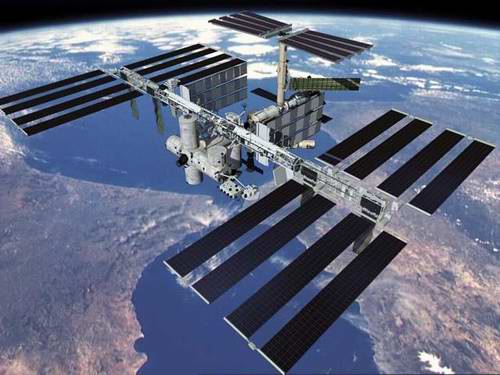
While space missions are usually done under the name of a particular country, they are usually supported by an enormous team of people from all over the world, making space exploration a profoundly international endeavour. Although nationalism was heavily intertwined with exploration during the 'space race', more recently it is often considered as more of a collaborative enterprise, epitomised by the most expensive man-made object ever to exist, the International Space Station. The view of our planet from space has ignited a new view of the world, with perspective shifting from a national to planetary level, as summarised by astronaut Donald Williams: "For those who have seen the Earth from space, and for the hundreds and perhaps thousands more who will, the experience most certainly changes your perspective. The things that we share in our world are far more valuable than those which divide us." This can only accelerate as journeying to space becomes more commonplace, and eventually available to not only astronauts the mega-rich.


Eradication of Smallpox

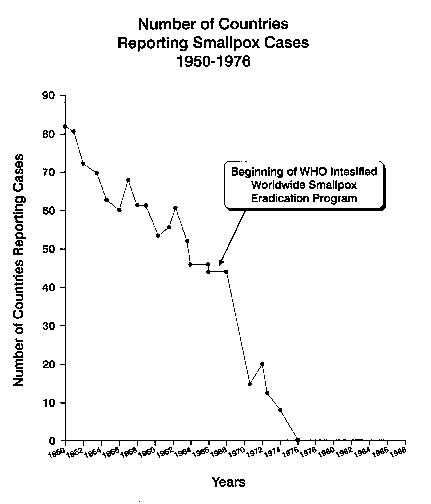
Over the 20th century, Smallpox killed between 300 and 500 million people - several times more than the total killed by both World Wars combined. Since the early 19th century, humanity has made efforts to wipe this scourge, which leaves many who survive it disfigured, from existence. Only in 1959, following a recommendation from the USSR's deputy health of health, was a concerted effort made to complete the job, eradicating what remained of it mostly in developing countries. In 1977 the last person was naturally infected, and two years later Smallpox was declared extinct, apart from a few strains remaining in storage possessed by the USA and USSR.

The eradication of Smallpox gave new hope to the similar extermination of diseases, including Polio and Malaria. For once we managed to wipe out a species that we actually wanted rid of (as opposed to the many hundreds, and possibly thousands that have become extinct due to our destruction of the natural environment) and saved many millions of lives as a result. Interestingly, the eradication Smallpox passed with little celebration - surprising for an event of such importance.


The Internet

The internet has come to dominate all spheres of civilization, from education and business, to social networking and journalism. The culmination of developments in communicative technology over the past century, it provided a place at which most human knowledge can be stored and accessed, and a hub for all types of media and art. It's true potential is only just being realised, and is likely to continue to increase in its effect on society and use in all walks of life.

The rise of the internet has lead to the creation of new dynamics, including instant messaging, social networking, memes (the funny pictures, and not the unit of cultural evolution), blogging (as you can see!) and so on. Arguably, our lives have been enriched more by the internet than by any other technological development, with the obvious exception of medical advancements. The achievement that is the internet is clearly not its creation alone, but also its populating with billion upon billion of web pages by many millions of people from every country in the world.


The Large Hadron Collider (and other awesome machines)

I'm lumping in machines like the first nuclear reactor (despite it's use in the first nuclear weapons), International Thermonuclear Experimental Reactor (ITER), National Ignition Facility (NIF) and various other particle smashers. The benefits of nuclear reactors are clear, providing clean (or at least somewhat cleaner than fossil fuels) energy with very little material, and the potential benefits of fusion reactors are even greater.

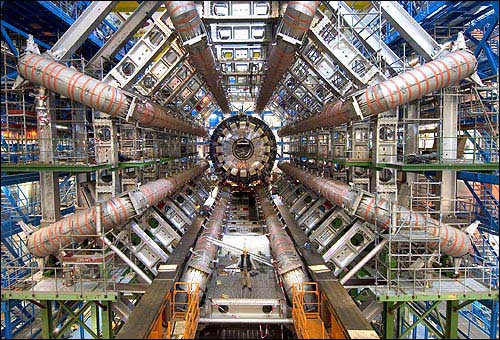
Many people object to the pure research that machines such as the LHC are involved in, on the grounds that it is costs an enormous amount ($4 billion) for no tangible benefit. This isn't necessarily true, as the construction of operating of the LHC has created and maintained jobs, and may have unexpected implications in the future. Without pure research there would be no applied research, and therefore no technology, so it is unreasonable to object to pure research. It is also difficult to establish whether a particular pure research project could produce anything directly beneficial in time, so the best course seems to me continuing pure research, if not only to satisfy human curiosity.

Note also that the cost of the LHC is less than what the world spends on it's militaries PER DAY - if there's a drain of resources that people should be complaining about, that is it!

These great machines are important not only for their use, but also for what they represent: the pinnacle of engineering and technical knowledge. Each is comprised of many millions of parts, precision engineered and fitted together to produce something that carries out something incredible, be it splitting atoms or smashing them together. They truly are testaments to our ingenuity and curiosity.


Artificial Intelligence

Obviously (at the time of writing) this isn't something that has been created yet, and is not likely to very many years. This would  be, in my opinion, the single greatest development that humanity could make, both past and future. The creation of a true AI would be revolutionary directly in neurology, and indirectly in everything from philosophy to gaming. As I've suggested earlier, AI could spark an unprecedented shift in technology, and society as a whole.

Interestingly, now that I've got to the end of the list (remember that this is not exhaustive) I noticed they tie in chronologically:

Space exploration: 1957 (Sputnik) onwards
Smallpox eradication: 1979
The internet: 1982
LHC: 2008
Arificial intelligence: 20?? (being a techno-optimist)


What does it mean?

You may have noticed a theme running through this article - that all of these achievements were international in scope. The point I would like to make is that far greater progress can be made through co-operation than competition, and that to tackle the great problems of our time necessitates greater collaboration and unity. Be proud of what our species has accomplished, and look forward to what it will achieve in the future!


Saturday, 30 June 2012

SETI: The Ultimate Search - Part 1

Well, it's been while since I last posted here, due to exams and such, but I should hopefully be able to write more frequently from now on. As the title suggests, this is about SETI (the search for extra-terrestrial intelligence if you really prefer), its worth, and its implications.


Where is Everebody?

SETI is what it says on the tin - the searching of the universe for other intelligent species like ourselves (at least some of the time), although not necessarily a lot like ourselves. Limitations on our current technology clearly prevent us from partaking in this search in person, so we've had to resort to listening for, and sending out, signals from and to outer space. We should first examine the likelihood that anyone is actually out there.

The good news is that someone has already beaten us to it, namely Frank Drake, with his formula know as the Drake equation, with which the number of communicating extra-terrestrial civilization can be estimated. The bad news is that the equation has seven variables, of which only two are known with any certainty, although we have some idea of the values of a couple of others. Here it is:


N here is the number of detectable extra-terrestrial civilizations in our galaxy, the Milky Way. Let's take each variable in turn, which become estimated with less and less certainty as you go on.

R, the average rate of star formation, is the one variable that we can be sure is about right. In our galaxy, around seven stars are formed each Earth year; no mean feat considering that each one is likely to last for many billions of years.

fp , the fraction of good stars (meaning stars that aren't pathetic white dwarfs, or over-sized giants) varies from around 20% to almost 100%. For the sake of neutrality, I'll go for the value in the middle: 60%.

ne, the average number of planets (or possibly moons, *ehem* Avatar *ehem*) that are capable of supporting life in those systems that have any planets at all, is a value that is only just now being investigated. Initial estimate suggest that perhaps around 10% of planets are capable of supporting life. If we take our own solar system as a rough guide, that works out to around one planet capable of supporting life. As a sample size of 1 isn't great, I'm going to use the, perhaps conservative, figure of an average of 0.2 earth-like planets per star.

fl , the fraction of those planets where life actually develops. For the purpose of not resorting to pure guesswork already, I'll use the figure of 0.2, based on the time that it took for life to develop on Earth.

fi , the fraction of planets on which life develops where a species evolves intelligence. I'm going to use an educated guess of 0.05, since, given enough time, the evolution of intelligence seems likely, but by no means certain.

fc , the fraction of those species that possess, and are using, communications technology. Again, I'm going to use the figure of 0.1, based on the length of time that we have been using communication technologies as a fraction of our total length of existence, past and future, and the possibility that some intelligent species struggle to form a civilization.

L, the length of the 'communicative phase', which is likely to correspond to the length that the civilization exists. This is an interesting variable which warrants longer discussion. There have been several points in our recent history at which we have come close to the end of civilization, all of which have been due to the threat of nuclear weapons, and indeed our continued future is threatened by climate change. However, it isn't as simple as working how long, on average, it takes for someone to accidentally detonate a nuclear weapon, or how long a species can keep their climate stable. This is because a civilization even a little more advanced than ours would be able to establish colonies on nearby planets and moons, and given a little more time, on the planets of other stars. When a species reaches this stage of development, they could become essentially immortal, even if their home star died (they could simply migrate to another). Therefore, I'm going to tentatively suggest an average of 1,000,000 years; still a tiny fraction of the total age of the universe.

And now, the moment of truth:

(7 x 0.6 x 0.2 x 0.2 x 0.05 x 0.1 x 1000000) - 1 [us!] = 839 detectable civilizations in our galaxy, and therefore about 80 trillion in our universe. But where on Earth (well, not) are they?


The Fermi Paradox

From the above calculation, it would seem that our galaxy, and universe, are abuzz with life. Unless you happen to believe the UFO nuts, you might have noticed that we haven't seen much of these 800-something civilizations, and don't even have a smidgen of evidence. This apparent contradiction is known as the Fermi Paradox.

One way to resolve the paradox is glaringly obvious - the calculation seems to be really quite naff, and it is indeed! If we change the values for the percentage of life-supporting planets that develop life from 0.2 to 0.05, and the fraction of intelligent species using communicative technologies from 0.1 to 0.01 (these change are not at all unreasonable, and would still be considered very optimistic by many), we now come to a figure of just 21. With just a little more adjustment and we can come to a figure of 1 or less.

There are many other explanations that have been proposed, including that a majority of civilizations destroy themselves too quickly (although this has already been taken into account in the equation), that most species have a policy of non-interference, much like the 'Prime Directive' of Star Trek, or simply that they don't want to communicate.


First Contact

Let's imagine that somewhere amongst the hundreds of billions of stars of the Milky Way, there is an intelligent species other than our own. How might contact happen, and what would be the consequences?

As suggested earlier, it's likely that initial contact would occur via communication technology; either with us receiving a message from outer space, or with them receiving one of our messages, such as the Arecibo message. You might be wondering how this is going to work, since we are certain to use utterly different language. Instead of our own languages, we have used the universal languages, of mathematics and science, which (probably) are the same for all intelligent beings.

However, this method of communication is severely limited by the many tens, or hundreds, of years that it would take for a reply to travel back across the vast expanses of space. Regardless, this is the only line of inquiry pursued by SETI organisations.

The most interesting form of contact, popularised in countless books, films and games, is that of direct contact; as in aliens visiting Earth in person. You many have noticed that a theme running through the portrayal of direct contact in these media sources is that this first contact doesn't often end well for Humanity.

In my opinion, it is unlikely that this would be the reaction of another civilisation to out own. For a species to survive its technological adolescence, it cannot have been so bellicose that it would attack other species on sight. A more likely response would be similar to our own; that they've just discovered another intelligent species, perhaps the first they have ever encountered, and that annihilation is not the best course of action.

What might be the effect of first contact on our own species and society? You'll have to wait for part 2 to find out...


- Daniel

Monday, 20 February 2012

Science is Interesting (and if you don't agree you can fuck off)

Obviously my fourth introductory article is about science (and don't worry - you needn't be exposed to any more offensive language. That is, if you don't watch the video below -  I know you won't be able to resist the temptation). 


What is Science?

Science (from Latin scientia, meaning "knowledge") is a systematic enterprise that builds and organizes knowledge in the form of testable explanations and predictions about the universe. Yes, that was copied and pasted from Wikipedia, I know, but this definition really doesn't do it justice. Science is the process by which humanity may undertstand the world it inhabits. It is the way that the universe (we are all products of the universe) may know itself.

Science has showed itself to be a brilliant, and probably unsurpassable, tool for ascertaining the truth of reality. It doesn't carry prejudices, hold grudges or work towards its own ends, even if the people who carry it out might not always reach these ideals. Science is universal, existing beyond religions, nation-states or ideoligies. Science binds us all together.

I could go on all day about how great science is, but I'm guessing that it would be preaching to the converted if you even got this far. So instead I've picked out my favourite fields in science, and I'll talk a little about each of them.


Medicine / Human Biology

This one's a no-brainer, not only because the human body is a truly fascinating thing, but because of the immeasurable benefits that this science has brought.

Walk over to the nearest mirror and take a look at yourself. You're staring at the product of 9 billion years of physcial and chemical evolution, from energy to the organic compounds that life is based on, followed by 4 billion years of biological evolution, from the simplest one-cell organisms to, well, you! Just think about the complex organs inside you, constantly working away to keep you alive, that have taken so long to come about.

While most sciences are driven more by curiosity (not to say that this one isn't), they usually only produce indirect benefits, whereas medical science can be translated directly into new treatments and procedures, benefiting humanity. We have medicine to thank for the fact that people with diabetes can live to adulthood, that being diagnosed with cancer is not an automatic death sentence, and that a majority of people live into their 70s and beyond (at least in developed countries).


Psychology

Go back to that mirror again and take another look at yourself (this is the final time, I promise). The fact that you can see yourself, comprehend what you see and make judgements, deductions and decisions based on this is, in itself, an amazing thing. The human mind is, in my own human-chauvinistic opinion, the most wonderful thing in the known universe. Its complexities and intriacies make it something unparalleled anywhere in nature, at least on our own planet (but that's something for another day).

Humans have walked on the moon, looked into the reality of the universe and have developed the ability to wipe out life on a planetary scale; all because of the phenomenal power of the human mind. Psychology is unique in that it is something (the human mind) trying to understand itself. It is probably the field of science that has the most unanswered questions, and the most profound implications.

There are a couple of interesting essays about approaches in psychology on my blog written by a friend which are well worth reading. Personally, I see the cognitive approach as the best path to follow in attempting the understand the human mind, in particular the computational model of the mind, in which the brain acts as a sort of incredibly powerful and versatile computer.


Physics / Astrophysics

Physics has a special place in my heart. For a while I was intent on pursuing it as a career, but decided that it would not bring about the direct benefit to others that medicine does, so should just remain as an interest.

But now to physics itself. Physics is usually considered to be the purest of the sciences if we don't include mathematics, as it deals with the universe at its most fundamental level. It is one of the most diverse fields in science, covering everything from gluons to galactic superclusters, and certainly one of the most interesting. Many of the big questions of physics have been answered to an extent, but many remain, most prominently the search for a 'theory of everything'.

Physics has recently made a come-back into the public interest, with major projects such as the Large Hadron Collider, discoveries such as the (possible) faster-than-light neutrinos, and even television programmes such as The Big Bang Theory. We live in an exciting time for physics (and television!).

I have a particular interest in astrophysics; the study of celestial bodies - stars, galaxies, nebulae, quasars, black holes and a whole host of others. What originally sparked my interest in astrophysics was the sheer scale of the universe and the structures it contains. The universe contains between 10 sextillion and a septillion stars. That's 1,000,000,000,000,000,000,000,000 stars, which is over a million times more than the number of grains of sand in all the deserts and beaches on the earth.


Here's your reward for getting to the end!


So that's science in a nutshell! If there's one section of my blog that there will always be something to talk about, it's this one.


-  Daniel


Psychology - The Psychodynamic Approach

Tuesday, 3 January 2012

Psychology - The Humanistic Approach


[NOTE: THIS WASN'T WRITTEN BY ME, BUT BY A FRIEND]

The Humanistic Approach to Psychology


In contemporary psychology, there are five approaches. An approach is a perspective that has certain assumptions about human behaviour, such as which parts of the mind are worth studying, the way they function and research methods on how to study them. The approaches are:
  •  Biological,
  • Behaviourist/Social Learning Theory
  • Psychodynamics
  • Cognitive
  • Humanist
This piece will describe and discuss the Humanist approach.

ORIGINS 

At the time when the approach was beginning to be developed, the two main approaches were the “First force” of Freud’s research of psychoanalysis and the “Second Force” of behaviourism which developed out of Ivan Pavlov’s research of conditioned reflexes e.g. his experiments with dogs salivating to conditioned stimuli. Psychologists met in the late 1950s to discuss creating a more holistic view of psychology that was concerned exclusively with human issues. These preliminary meetings lead to other developments, resulting in the description of humanistic psychology as a “third force” in psychology, along with the other two that have been described. The Association for Humanistic Psychology was formed in 1961, and in 1971 was recognised by the American Psychological Association.

BASIC ASSUMPTIONS

  • Each person is a unique individual, and psychology should focus only on the subjective experiences, and that to understand a person it is necessary to understand their emotions, feelings and thoughts. This is one of ways in which humanism is different to the other approaches, because this view is ideographic. If all of us are different there cannot be universal laws of behaviour which the other approaches attempt to develop.
  • People have free will over their actions and can develop as they want, achieve what they want in life, and not be determined by any other aspect, unlike the other approaches.
  •  People must be looked at from a “holistic” view, and behaviour cannot be reduced down into component parts and simple explanations, as is done in the cognitive, behaviourist and biological approaches, or else we lose what it is to be human.
  • People are inherently good and are driven to fulfil their potential.

The feelings of humanist psychologists are that people are more than “robots” driven by the environment or, as Sigmund Freud claimed, by unconscious forces and conflicts.

Humanists reject determinism (that there is no free will and behaviour is determined by aspects out of human control) and reductionism (reducing behaviour down to simple explanations) as well as the usefulness of scientific psychology.

METHODOLOGY

The approach does not use scientific experiments, as it believes they are dehumanising, and also lower the ecological validity of results as people will behave differently in a lab than in “real life”. The approach instead uses qualitative methods such as case studies and interviews in research. 

IDEAS OF THE HUMANISTIC APPROACH

 Two of the formulators of the ideas of humanistic psychology are Carl Rogers and Abraham Maslow.

Carl Rogers emphasised the importance of self-concept and created what is known as client-centred therapy, or more often, Rogerain Counselling, whilst Maslow was more interested in the motives that drive people.

CARL ROGERS

Carl Rogers was the primary formulator of the ideas of the humanist approach, and shared the general assumptions of humanist psychology with other humanists. He also believed that each of us perceives the world in our own unique way, and to understand what someone does you have to see the world as they do. He also believed that people had the innate tendency to “self-actualise”, which refers to people having the ability to achieve their potential in life. This potential can be academic, sporting, artistic etc., which is a much more positive view of human behaviour than the other approaches, which are often quite depressing. This is also manifested in any living thing, such as the flower that forces its way through paving stones and the forest ecosystem that spreads to be as large as it can.
 
Some of his other ideas are:

Organismic Valuing

This is the idea that every organism has the innate idea of what is good or bad for them. E.g. a baby that dislikes its food will spit it out. People will tend to move away from situations that threaten them or cause harm.

Positive Self Regard

This is a sense of self-worth or self-esteem. If we lack this, then our path to achieving our potential will become disrupted or blocked. An example of this is academic failure and disruptive behaviour from school children will low self-esteem who believe they are not good enough.

Unconditional Positive Regard

We need to be loved, valued and respected by others - it is a precondition to our development. If a child is fed and cleaned, but not loved and nurtured, it will not develop and thrive. This love, value and respect must be given without conditions or else we will not gain positive self-regard.

 Conditions of worth

The positive regard of others must not have “strings attached” or conditions, but it normally does. Over time this may result in conditional self-regard, where we believe we only have worth if we meet the conditions that have been imposed on us by society through family, friends, media etc. Examples are “I am not rich therefore I am unhappy” or “I must pass my exams, else I am worthless”.

One question that Rogers asked is why, when we live in a society that in many ways is so affluent, many of us our unhappy. In his view, at least partly, is that the things we attach value to are not things that are necessarily good for our psychological well-being. What he believed was the problem is that society can interfere with our actualising tendency. Certain things that society (through our parents, friends, teachers, media etc.) tells us are important are not necessarily the things that are actually good for our development as people. As a consequence, we continually labour to fulfil these goals which are conditions of worth, and these may not be helpful in helping us achieve our goals. As we perceive the regard of others as conditional, we only value ourselves in relation to the conditions of worth we meet that have been imposed on us. Incongruity is created when there is a gap between the “real self” which is what we could become, and the “ideal self” which is what we think we should become. If we are set for a life where we continually try to achieve the goals, and so conditions of worth that have been set for us by others, we are set for a life of unhappiness.

To try to deal with this we have defences, which are employed to cope with the feelings of anxiety associated with incongruity. An example is denial, such as when a student who doesn’t turn up for an exam never has to face bad grades. Another is distortion, where a student may blame a teacher for poor teaching or an unfair test for bad grades. These defences distort our perception of reality or deny parts of it, and if you are not in touch with reality you will lose touch with aspects of it, and be unable to accurately understand your place in the world. As a result you will never achieve your potential - the only thing that will give you a more contented life.

And so we pursue the goals that we think will make us happy. The next pay rise, the next partner, the next piece of clothing, etc. will finally make us happy, but it never will.

The fully functioning person

Roger’s didn’t use the term “happy” when describing psychologically healthy people, even if this is what he meant in essence. He used the term “fully function person”, which is somebody whose mental set-up puts them in a position to achieve their potential. He believe that they are:
  • Open to experience – they don’t distort the world
  • Living in the ‘here-and-now’ – they don’t dwell on the past or worry about the future
  • Doing what’s good for them – they trust organismic valuing to guide their decisions and choices
  • Experientially free – they feel as if they are in control of their lives, rather than being constrained
  • Creative – They contribute to the actualisation of others through art, science, parenting or their job

Client-centred Therapy

We cannot make people happy (or fully functioning). If we try to change them or tell what to do, because this would be imposing a condition of worth upon them, adding to the problem.

In client-centred therapy, conditions are created under which a person can start to make their authentic choices, and support them through the changes they decide to make.

Roger’s compared it to riding a bike. You can’t tell a person how to do it, as they will only learn through trying. You can support them while they learn, but if you never let them go they will never be able to do it independently.
 
Rogers believed that successful therapy or counselling has more to do with the relationship the therapist develops with the client than with the techniques used by the therapist.

If the therapist can develop the right sort of relationship, they can give the client room to examine their own problems, sources of unhappiness and perception of the world. Once they can do this they can make the changes they want. Rogers identified three important qualities that the therapist must have with their client in their relationship:

  • CONGRUENCE – Honesty and genuineness. The therapist must relate to the client as one human being to another, rather than as a professional, such as a doctor.
  • EMPATHY – The therapist must be able to feel what the client feels, because this is the only way for the client to feel as if they are genuinely understood.
  • RESPECT – The therapist must show acceptance and unconditional positive regard for the client, as the lack of unconditional positive regard is often the source of the client’s unhappiness.
The main technique used is reflecting back to the client what they have said, which involves demonstrating to the client that they are really understood, whilst at the same time helping them explore their feelings and perceptions so they can arrive at their own understandings.

ABRAHAM MASLOW

Like Roger’s, Maslow believed that people are driven to fulfil their potential. His view is that we have certain needs that we need to fulfil. As we take care of one group of needs, another group becomes more important. Much of his work was focused on identifying the needs that people have, and why some fulfil their potential more than others.

Whilst Rogers was concerned with the self, Maslow was concerned with the motives that drive people, and he believed that there were two kinds: (1) Deficiency Motivation – the need to reduce psychological tensions such as hunger and thirst, and (2) Growth Motivation – which is the motivation to satisfy the need to be loved and esteemed.

The growth motives operate on the principle that, when no deficiencies remain, people then have the need to develop beyond their current condition.

Hierarchy of needs

Maslow thought that we are driven to fulfil our needs, but some take priority over others. For example you may be hungry, but you may forget it if you are thirsty, and you will certainly forget your thirst if you can’t breathe. In other words, some needs are felt more strongly than others. Maslow looked at how strongly each need was felt, and was then able to arrange them into a hierarchy.

The needs in order of priority, with those most strongly needed to be satisfied at the bottom:

  • Self-actualisation – fulfilling you human potential
  • Esteem – being respected by others, and having status and recognition
  • Love and belonging – love, friendship and a sense of community
  • Safety – freedom from threat and danger
  • Physiological – food, water, oxygen etc.
In our development, we move through the levels of the hierarchy. An infant is only concerned with its physiological needs, and then it becomes aware of its need for safety, then to love and be loved. Later it begins to feel the need for self-esteem, and so on.

Depending on how our lives turn out, we generally reach a level where our most important needs are satisfied. Our activities become habitually directed to meeting the next set of needs that are to be satisfied, which become our salient needs.

However at times we may become stressed or under threat, and so may regress to meeting more basic needs. For example, you may have esteem needs as your salient needs, but if you lost a partner, love and belonging become priorities, and your needs for esteem are put on hold.

Problems or crises at a point in a person’s life can cause them to fixate on a particular set of needs, and this can affect their future happiness. A person who lived through a period of extreme deprivation may satisfy their salient needs, but may become obsessed with money or keeping enough food in their house.

Maslow believed this was the cause of neurotic mental health issues, such as anxiety or depression.

Self-Actualisation

Maslow believed that those who have met their deficit needs, and engaged with growth needs, might reach the stage of self-actualisation. Such people tend to be remarkable individuals, such as Abraham Lincoln or Martin Luther King, and so have made the most of their human potential.

The characteristics of these people are:

  • Reality centred – they can tell the genuine from the fake in people
  • Problem centred – they view life’s difficulties as problems to be solved
  • Autonomous – they are relatively independent
  • Non-conformist – they do not respond to the social pressure to fit in
Self-actualisers, as Maslow identified them, also tend to prefer solitude, have a few important personal relationships rather than many shallow ones, a non-hostile sense of humour, very accepting of themselves and others, and have a strong sense of morality and ethics. They are not perfect individuals and may harbour certain flaws or problems, such as being prone to suffering from anxiety and guilt, being absent minded, being overly kind, occasionally lose their sense of humour, or even being ruthless.

EVALUATION

Client centred therapy has shown to be effective in treating mild psychological disorders, and in explaining abnormal behaviour such as low self-worth and phobias.

The approach is optimistic about people, as it recognises that people have free will and are responsible for their own actions - not controlled by their environment or the inner unconscious. It also recognises that our experiences are important.

However, the rejection of scientific methods in explaining and investigating means that its theories and concepts cannot be investigated properly. For instance, how do you quantify incongruity? Without empirical and quantitative data, the humanist approach must use case studies and interviews, which are rich in detail, but are subjective and therefore unreliable.

Roger’s own concepts are culturally bound e.g. self-actualisation is focused on the individual in a western culture. As a result it doesn’t deal with group achievements that may be more important in an eastern culture.
Focusing on the individual means that the approach does not look at what people have in common with one-another.

Despite its limitations, the humanistic approach  has been significant and useful as the “third force” of psychology, and has made psychologists think carefully about what the subject matter of psychology should be. It has made them recognise the importance of people’s personal experiences, what they think and how they feel.


- Kristian Smith