Dear AQA,
I am a student in year 13, currently studying for A2 Biology, Chemistry and Physics. The bizarre nature of the ISAs (Investigative Skills Assignment) set by AQA has been apparent to me since GCSE, but now that the scores I receive are so important to mine, and my peers, futures I felt it necessary to pursue. The key problems that I have identified are as follows:
1. The exam is internally sat and assessed, without the need for external invigilators. It is common knowledge that some schools will drop hints on what will be on the written section of the test, with some going so far as to tell students what will be on it. This creates inequalities between those with schools that are prepared to abuse the system and those that are not.
2. The exam is sat at different times between schools and between classes in individual schools. This means that the questions on the written part of the ISA can be freely shared between students, putting those who sit in early on in the period at a disadvantage, and those who sit it later at a great advantage.
3. The above two points, combined with the generic nature of the test, have led to scores becoming bloated to ludicrous levels. Using the UMS converter for ISAs, it can be seen that half marks will usually result in a notional N grade, and full raw marks are usually required for full UMS. Even a few marks often makes the difference between two grades, making it an assessment that does not properly measure candidates' ability. By means of example, an extremely able former student at my school, now at University, achieved full UMS in BIOL1 and BIOL2, but a grade C in BIOL3T. I have heard many similar stories.
I would be interested to know AQA's rationale for allowing such flagrant abuses of the examination system, and for its lack of interest in accurately assessing students' ability. I would also like to know what steps you plan to take, if any, to remedy these problems.
Regards,
Daniel Hurt
I'll keep you posted!
Showing posts with label Other.... Show all posts
Showing posts with label Other.... Show all posts
Sunday, 9 December 2012

Thursday, 9 August 2012
Amnesia: The Dark Descent - The Art of Fear
About Amnesia
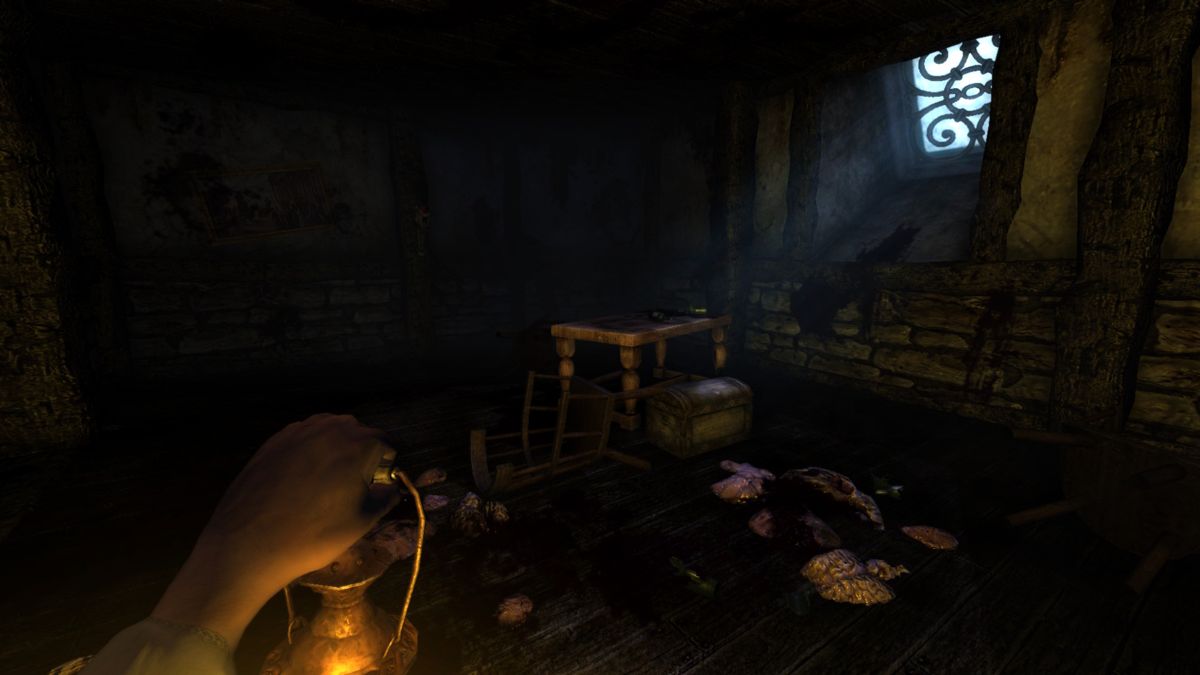
First things first, Amnesia is a horror game developed by Frictional Games. It follows the story of protagonist, Daniel (BONUS!), after he wakes up the suspiciously empty castle of Brennenburg, muttering about his name and rolling around the floor a little. This is the only information that the game gives you at the beginning, initiating fear immediately through the sense of mystery and feelings of vulnerability.
 You quickly find items called 'tinderboxes', which you can use to light most light sources in the game. Soon after you find the only equipable item in the game, the lantern, which has a finite fuel supply that can only be replaced by finding even more limited oil flasks. You are forced to actively conserve tinderboxes and oil, lest you be left in darkness, which will drain your sanity (Daniel suffers from nyctophobia and necrophobia - not great in a castle filled with both darkness and corpses). If you end up on low sanity because you've spent to long in darkness, or see too many 'unsettling events', your vision begins to go blurred, and you will eventually collapse onto the ground, crawling. Again, not fantastic when you're about to get eaten by a hungry looking monster with a jaw as wide as its arm is long.
Even better, you can do absolutely nothing about these monsters, other than hide, run or simply avoid them altogether. No guns. No swords. You can't even punch the blasted things! You are completely defenceless, leading to paranoia and a lot of hiding in corners. Don't try negotiating with them, or offering shiny trinkets that you've gathered on your journey - it just makes that angrier. Looking at the things will drain your sanity further, and will cause your vision to become distorted (see picture).
The game is comprised of 3 main elements - avoiding/running from/crying-in-corners-until-they-pass monsters, completing puzzles and exploring the castle as you descend deeper and deeper through its many levels. That should give a good overview of the game, so I'll now go to what makes it quite so scary.
Generating Fear
"I don't see what's so scary about it? It's all just on a screen so it can't hurt you."
- My sister
Oh, if only it were so simple! Yes, perhaps if you just threw caution to the wind and ran through the entire game fearlessly, it might not be so scary, but if you actually want to experience it fully you need to do what it says at the start (play in the dark, don't expect to 'win' and let yourself enter the world of Amnesia.) Instead of rambling about what makes Amnesia scary, I'll instead examine the three components (in ascending order) that I found to be the most important in generating the extreme fear that I, and most who play it, felt.
The first of these is the plot, including the scripting of certain events and monster appearances. The plot itself is very dark, as only revealed incrementally mostly through diary extracts you find lying around. There are numerous references to torture, murder and kidnapping, with the descriptions and flashbacks becoming more and more vivid as the game progresses. I found this to be particularly draining, especially the very disturbing 'torture rooms' areas in the late-game, bathed in an eery red glow and rapidly draining your sanity.
 The scripting of events is very intelligently done - there are only a few 'jump-out' scary moments, and these are done with such rarity and built up so well that they are genuinely terrifying (I literally started flailing during one of them...) This is in stark contrast to games that rely almost entirely on this type of scare (Dead Space, etc.), and the novelty quickly wears thin, with them becoming predictable. The main horror drive of the game comes from careful pacing, and careful placement of monsters and events that leave you afraid to turn the corner, or take a few steps down a darkened corridor. There is, in fact, only a relatively small number of times that you will encounter monsters, and in many of these the monsters present no real threat. The strength of the game is that it keeps you guessing, and trying to predict where there will be monsters, and then surprising you when they're not around the suspicious-looking corner.
*SPOILER PARAGRAPH* One thing that I noticed to be very powerful was the revisiting of previous areas, which act as 'hubs' connecting to several areas. This is done in many games become it gives the player a sense of reassurance and achievement if they have completed an objective before revisiting, but Amnesia turns this on its head, often having the hub transformed (an example is a nice fountain which fills with blood and has a corpse lying in it), or mostly destroyed by the supernatural being known as 'The Shadow'. A similar device used is the destruction of the feeling of safety in certain areas. Fairly early on in the game, you reach what used to be your bedroom, which comprises of three small well-lit (a blessing in Amnesia!) rooms. You feel like you could just spend a few minutes recovering from stumbling through dark corridors with the sound of monsters around you, until you here groaning and something beating down the door. Although this encounter isn't particularly dangerous (you can just hide in your trusty closet until it finishes messing up your room), it certainly made me doubt the safety of even the nice areas of Amnesia, destroying the last places of refuge in the game for me.
On to the second of the components; the monsters themselves. The design of the monsters are outstanding for the purpose of scaring the player. Importantly, they are recognisable as human, but are horrifically deformed. Although I can't speak for everyone, I literally wanted to avoid looking at them, not only to conserve my sanity and to avoid them seeing me, but because they are actually scary in their own right. Not only their appearance, but their shuffling movements, their nightmare-haunting moans, and even the ominous music that accompanies them, are terrifying.
 The formula for monster encounters is also clever - you look at them, they usually look at you, then you must run and hide with them hot on your heels. The adrenalin rush of some of these chases can be overwhelming, and can often warrant taking a break to calm back down (or at least they did for me, as easily scared as I am.) There are no monsters jumping out of cupboards, or similar cheap scares, and you will often see the monster before they see you, if you're fortunate.
The final, and most potent element of the game, for me, may be surprising - the sound. From the dreaded 'chase music' to the haunted cries that echo around the depths of the castle, the sounds of the game are what really make the atmosphere. What was that? It sounded like footsteps. Perhaps it's through that door. Or maybe it's above me. The sounds keeps you guessing and worrying, and the sound of wind through an opening in the ceiling can still make you jump if you're already put on edge.
Some people have suggested that you could remove the monsters to make the fear of the game more manageable (many people do struggle to play Amnesia for more than an hour before giving in), but I think that the simple removal of the background noise and music would be enough to almost neutralise the fear of the game, perhaps leaving it almost comical. I was unable to find the willpower to use headphones as suggested, but I am sure that it would have made much of the game utterly unbearable.
Notable mentions go the lighting, which is not excessive, nor is everything shrouded in darkness, to the use of the 'sanity meter' to provide additional impetus to stay in the light and avoid monsters, and also to physical design of levels. The claustrophobic, mazing passages of the prison, or the dank, water-filled chambers of the cistern, were enough to stop you in your tracks for a while, until you work out the safest path and second-guess where monsters could be.
Conclusion
Amnesia is a masterpiece of the horror genre, and perhaps even of the gaming world. It pushes almost every fear button that our species has - the dark, human-like monsters, death, torture, vulnerability, running from an unyielding enemy, the unknown and even the odd spider. What I've said here only scratches the surface of Amnesia, and you will not be left unsatisfied if you decide to play it in the way that it suggests. The pure dread that I felt as I wandered down those dark corridors clutching my lantern, almost out of oil, is unmatched by any other game I've played, film I've watched or book I've read.
Try it out for yourself! Or are you too much of a chicken? ;-)
- Daniel
Thursday, 29 December 2011
Introduction
So, this is my blog. I thought I should probably give a little introduction to myself, and to the blog.
As you can see from my personal information to the right, I'm a sixth-form student living in the UK, with a keen interest in Science, Technology, Ethics, Philosophy, Politics and Sociology (S.T.E.P.P.S, if you hadn't worked it out yet). I study maths, biology, physics and chemistry for AS level, and hope to go into medicine after leaving school. So that no one reading this is under any illusions, I'm a humanist and a socialist (deal with it!) Now I'll give a introduction to the different topics covered by my blog:
Science: Science (from Latin scientia, meaning "knowledge") is a systematic enterprise that builds and organizes knowledge in the form of testable explanations and predictions about the universe (shameless Wikipedia copying and pasting, I know). But there's more to science than that. It is, as far as we know, the best tool for understanding everything in our universe, from the quark to the galaxies, and from the virus to that most wonderous of things; the human brain. Science is the basis of almost everything that we take for granted in our technical civilization, from light bulbs to the space shuttle. Without a doubt, science is the most important element of our humanity - the drive to discover, to explore and to better ourselves.

Technology: Technology, in short, is the application of science to design, construct and use tools (of widely varying complexity) to perform a specific function. When I talk about technology, I don't mean the gadgets that various companies churn out (ehem... ipods, iphones...) that add little to our lives (apart from fun of course!), but the technology that can help us to grow food, to travel around our planet in a matter hours, or to explore the universe. I'll look at the technology that really adds something to our society, and especially important emerging fields of technology, such as nanotechnology and the development of artificial intelligence.
Ethics: Ethics is a branch of philosophy that is used to decide what is considered 'moral' or accpetable to do. It's a wide-ranging topic, covering issues from justice and crime to animal rights and medical ethics.
 Philosophy: Philosophy is, as I like to think it, the waiting room of science. It is the place for questions that we can not yet answer using our preferred method, science, but that must wait for perhaps hundred of years, or may never be fully answered. It's the place of the really big questions that make your head hurt if you think too long about them, like "What is the meaning of life?" (other than 42 [haha...]) or "Why are you you?" Philosophy has evolved considerably from its roots millenia ago, and has narrowed somewhat, as parts of it have moved out of its own realm, and into the realm of science. However, it still has many crucial, unanswered questions that are well worth considering.
Politics: *Yawn!* Yes, politics can be boring, espeically in our two-party state, vote-every-four-years media circus, where all the parties are continually at eachothers throats about everything. Accordingly, I'll try not to look at every tiny decision that various governments make, but more at the interesting trends in politics, such as the sudden rise of the far right, or what the global economy might look like after (and if!) it begins to recover.
Sociology: This is the one that not as many people have heard of. Sociology is, in short, the scientific study of society. This makes it overlap significantly with the other five topics, making it of particular interest to me. It deals with issues such as war, nationalism, racism and why no one likes gingers (no offence). I'll explore events, such as the summer riots, as well as long term trends, such as the decline of religion, especially in developed countries.
Other: I'll probably end up sticking in the odd book, film or game review, anything interesting that happens in my life (there really isn't much, trust me) or whatever else I feel like writing about.

Well, that's an introduction. If you'd like any more information about the blog, would like to make any suggestions or would like to contribute an article, just comment (and please don't be too harsh on me - this is my first ever blog post...)
Also, apologies for the labels at the top being out of order. It won't let me arrange them as I want... If anyone knows how to sort them I'd be grateful for some advice.
- Daniel
As you can see from my personal information to the right, I'm a sixth-form student living in the UK, with a keen interest in Science, Technology, Ethics, Philosophy, Politics and Sociology (S.T.E.P.P.S, if you hadn't worked it out yet). I study maths, biology, physics and chemistry for AS level, and hope to go into medicine after leaving school. So that no one reading this is under any illusions, I'm a humanist and a socialist (deal with it!) Now I'll give a introduction to the different topics covered by my blog:
Science: Science (from Latin scientia, meaning "knowledge") is a systematic enterprise that builds and organizes knowledge in the form of testable explanations and predictions about the universe (shameless Wikipedia copying and pasting, I know). But there's more to science than that. It is, as far as we know, the best tool for understanding everything in our universe, from the quark to the galaxies, and from the virus to that most wonderous of things; the human brain. Science is the basis of almost everything that we take for granted in our technical civilization, from light bulbs to the space shuttle. Without a doubt, science is the most important element of our humanity - the drive to discover, to explore and to better ourselves.

Technology: Technology, in short, is the application of science to design, construct and use tools (of widely varying complexity) to perform a specific function. When I talk about technology, I don't mean the gadgets that various companies churn out (ehem... ipods, iphones...) that add little to our lives (apart from fun of course!), but the technology that can help us to grow food, to travel around our planet in a matter hours, or to explore the universe. I'll look at the technology that really adds something to our society, and especially important emerging fields of technology, such as nanotechnology and the development of artificial intelligence.
Ethics: Ethics is a branch of philosophy that is used to decide what is considered 'moral' or accpetable to do. It's a wide-ranging topic, covering issues from justice and crime to animal rights and medical ethics.
 Philosophy: Philosophy is, as I like to think it, the waiting room of science. It is the place for questions that we can not yet answer using our preferred method, science, but that must wait for perhaps hundred of years, or may never be fully answered. It's the place of the really big questions that make your head hurt if you think too long about them, like "What is the meaning of life?" (other than 42 [haha...]) or "Why are you you?" Philosophy has evolved considerably from its roots millenia ago, and has narrowed somewhat, as parts of it have moved out of its own realm, and into the realm of science. However, it still has many crucial, unanswered questions that are well worth considering.
Politics: *Yawn!* Yes, politics can be boring, espeically in our two-party state, vote-every-four-years media circus, where all the parties are continually at eachothers throats about everything. Accordingly, I'll try not to look at every tiny decision that various governments make, but more at the interesting trends in politics, such as the sudden rise of the far right, or what the global economy might look like after (and if!) it begins to recover.
Sociology: This is the one that not as many people have heard of. Sociology is, in short, the scientific study of society. This makes it overlap significantly with the other five topics, making it of particular interest to me. It deals with issues such as war, nationalism, racism and why no one likes gingers (no offence). I'll explore events, such as the summer riots, as well as long term trends, such as the decline of religion, especially in developed countries.
Other: I'll probably end up sticking in the odd book, film or game review, anything interesting that happens in my life (there really isn't much, trust me) or whatever else I feel like writing about.

Well, that's an introduction. If you'd like any more information about the blog, would like to make any suggestions or would like to contribute an article, just comment (and please don't be too harsh on me - this is my first ever blog post...)
Also, apologies for the labels at the top being out of order. It won't let me arrange them as I want... If anyone knows how to sort them I'd be grateful for some advice.
- Daniel
Subscribe to:
Posts (Atom)